
The short version
- CNBC reported that 20 of the most valuable AI and chip stocks lost more than $1 trillion in value in a few days in mid-October 2026. Nobody knows if this is the start of something bigger.
- Your AI bill did not change. The risk is indirect: AI vendors depend on investors and lenders, and when money tightens they can raise prices, add limits, retire products or fail.
- The cheapest protection is boring: know what you use, read your exit terms, keep your prompts and data, and track shutdown dates.
- Do not panic-cancel. Make your setup easy to move, then keep using AI where it saves money.
What happened
In the week of October 12, 2026, shares tied to artificial intelligence fell hard around the world. CNBC reported on Thursday, October 15 that 20 of the most valuable global AI and semiconductor stocks had shed more than $1 trillion in value so far that week. That is a mid-week tally for a group of 20 companies, not a final weekly total, and prices have moved since.
Three reasons were given:
- Borrowing costs. Investors worried that higher interest rates would make the huge spending on AI data centers harder to pay for. A hotter-than-expected US inflation report had pushed the Nasdaq down 1.88% the day before, on fears that the Federal Reserve could raise rates further.
- Financing. The chief executives of Broadcom and Intel warned that financing could become a major headwind to the AI boom. Broadcom's Hock Tan said it could be a bigger challenge than shortages of chips or electricity.
- Competition. Fears of a glut of memory chips, and a claimed breakthrough from a Chinese memory maker, added to the pressure.
Not everyone read it as a crisis. One analyst quoted by CNBC, Dan Ives of Yorkville Ives, said the sell-off reflects the cost of financing, while demand for AI computing power remains robust: "rates are a financing question, not a demand question." Nvidia's chief executive, Jensen Huang, also told Bloomberg that the cloud company CoreWeave's cost of capital was actually decreasing.
Is it a bubble? Nobody knows. Markets overshoot in both directions, and a few bad days do not prove either story. This guide does not try to predict prices. It asks a narrower question: if the money behind AI gets tighter, what could change for a business that just pays for AI tools?
How it could reach you
Picture a dental clinic in Ohio that uses an AI receptionist, a Berlin online shop with an AI product-description tool, or a Manchester accountant whose team drafts client letters with a chatbot. None of them own a single AI stock. Three things can still land on their desk.
1. The vendor gets into trouble
Many AI companies spend far more than they earn while they grow, funded by investors and lenders. That works until the money gets expensive. A famous name and a big funding round are not a guarantee. The British software company Builder.ai, backed by Microsoft and Qatar's sovereign wealth fund, had raised over $450 million when it announced in May 2025 that its main unit would enter insolvency proceedings. Its statement said the priority was to support employees, customers and partners while working with administrators.
That is one company in one year, and Builder.ai had its own accounting troubles. The point is the pattern: when a vendor fails, an administrator or a buyer decides what happens to your access and your data, and your say is limited.
2. Prices, plans and limits change
When AI costs more to run than customers pay, vendors adjust the plan. A real example from a time unrelated to this sell-off: in January 2025 Microsoft added Copilot to its consumer Microsoft 365 Personal and Family plans and raised US prices by $3 a month, with existing subscribers paying the new price from their next renewal. The new plans came with a monthly allotment of AI credits, which is a cap, and cheaper plans without Copilot were offered to existing subscribers for a limited time. That was a consumer product, not business software, but the pattern is the useful part: AI features, new prices and usage limits tend to arrive together.
3. The product you built on is retired
This one happens in good times too, and it is the most likely to hit you. AI companies retire older models and tools on a schedule. Some current examples, all from the vendors' own pages:
- OpenAI told developers on October 14, 2026 that certain GPT-4o and GPT-4.1 models will be removed from its API on January 14, 2027.
- OpenAI's Assistants API was scheduled to shut down on August 26, 2026, and its Agent Builder and reusable prompts feature are scheduled to shut down on November 30, 2026. Its advice for reusable prompts is to move the prompt content into your own application code.
- Anthropic told developers on September 30, 2026 that Claude Sonnet 4.5 will be retired on November 30, 2026.
Both companies promise notice. OpenAI's page says at least 6 months for generally available models, at least 3 months for specialized variants and as little as 2 weeks for preview models. Anthropic's says at least 60 days. Anthropic also says it retires models to ensure capacity for new releases. A money squeeze would not create this habit, but it could speed it up, because every old model kept running costs computing power.
Related guideYour AI pilot worked. Then the bill arrived.Eight ways to cut AI running costs before a price change forces the issue.Warning signs to watch
Ives named three signals that would show real trouble in the AI industry, as opposed to a nervous market: cuts to cloud providers' data center spending, canceled contracts and falling prices to rent AI chips. You are unlikely to track those, so watch the signs closer to home:
- MoneyFunding news. A vendor that stops announcing funding, lays off staff, or has a founder step down deserves a closer look. Builder.ai cut about 35% of its staff a month before its insolvency announcement.
- PriceYour pricing page. New tiers, new "fair use" limits, or a feature moved to a higher plan are early signs of cost pressure.
- ProductDeprecation notices. An email titled "important changes to your plan" or a shorter-than-usual shutdown date is worth reading the same day.
- ServiceSlower support and flakier uptime. Slower answers, more outages and unexplained quality drops can mean a vendor is cutting costs.
The first, third and fourth signs are our own suggestions, not predictions from any source. They are cheap to watch and cost nothing to ignore if they turn out to be false alarms.
Seven steps to take
None of this requires a technical team. Most of it takes an afternoon, and it protects you whether the market recovers next week or not.
- List every AI tool and what depends on itWrite down the tool, who owns it, what it costs, what data it holds and when it renews. Include the ones staff signed up for on their own.
- Read the exit termsFind the notice period for price changes, the way to cancel, what happens to your data if the vendor is sold or fails, and whether you can export it in a usable format. Be careful with multi-year prepaid deals from smaller vendors, because prepaid fees can be hard to recover if a company fails.
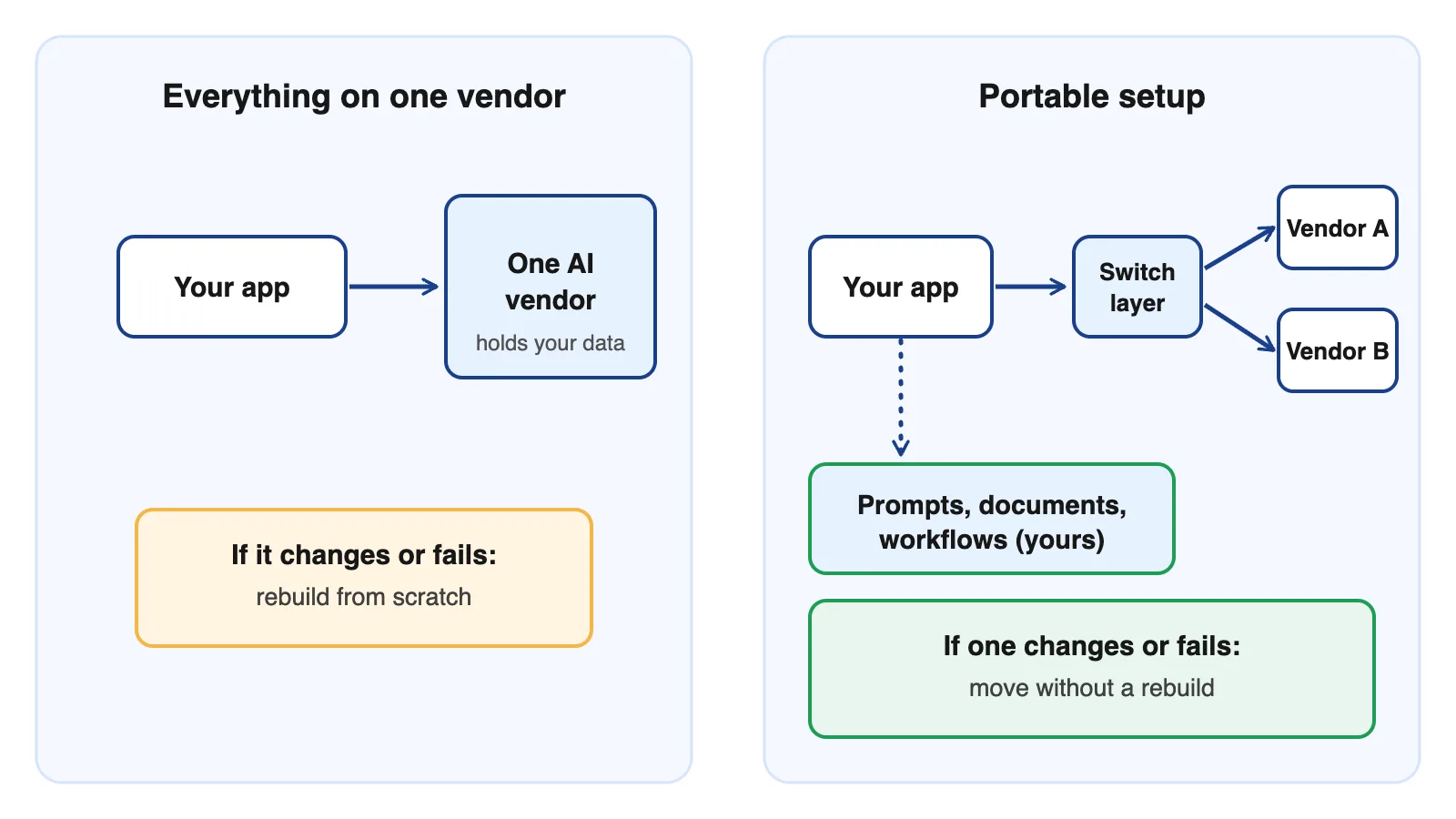
- Keep your prompts, documents and workflows in your own handsStore them in your own files or repository, not only inside a vendor's builder. OpenAI's own guidance for retiring reusable prompts is to move them into your code, which is exactly this advice.
- Do not hard-wire one modelHave your tools call the AI from one place, so switching providers is a setting, not a rebuild. Every quarter, run your three most important tasks on a second provider so you know it works.
- Track shutdown datesOpenAI's models list includes an optional shutdown date field for each model. In Anthropic's console you can export a usage report by model to find any deprecated models still in use. Put the dates in a shared calendar.
- Set usage caps and alertsUse the spending limits and budget alerts your vendors offer, and cap how many times an agent can call a model per task. If prices rise, a cap turns a nasty surprise into a known ceiling.
- Keep a manual fallback for what cannot stopFor customer support, invoicing or anything with a deadline, write one page on what the team does the day an AI tool disappears.
Do not over-react: we found no evidence that this sell-off has raised prices or closed any AI product. Canceling working tools out of fear costs real time and money. The goal is to be able to move if you need to, not to move now.
If you find AI tools your team uses without approval while you build the list, that is a separate risk with its own fixes. Our guide to shadow AI covers it.
Related guideYour team is already using AI. Do you know which?How to find unapproved AI tools and what to put in place.Questions people ask
Will an AI stock sell-off raise the price of my AI tools?
Not directly. Share prices do not change your invoice. The link is indirect: AI companies fund huge computing costs with investor money and debt, so when money gets more expensive, vendors may change plans, add usage limits or raise prices. We found no evidence that this sell-off has done that yet, so treat it as a risk to prepare for, not a fact.
Is the AI bubble about to burst?
Nobody knows, and anyone who says they do is guessing. The analysts quoted by CNBC split on this: some worry about the cost of financing AI buildouts, while one argued the problem is financing, not demand, and that cuts to data center spending, canceled contracts or falling GPU rental prices would be the real warning signs.
What happens to my data if an AI vendor goes bust?
It depends on your contract, which is why exit terms matter. An administrator or buyer takes over the company, and your access and data can be disrupted while they decide what to do. Keep your own copies of prompts, documents and outputs, and check the contract for data export and deletion terms before you need them.
How much notice do AI vendors give before retiring a model?
It varies. OpenAI's documentation promises at least 6 months for generally available models, at least 3 months for specialized variants and as little as 2 weeks for preview models. Anthropic's documentation promises at least 60 days for publicly released models. Check the current page for the exact model you use.
Should we switch to open models or host our own to be safe?
Not as a reflex. Running your own models adds costs and skills you may not have, and idle GPUs are expensive. A cheaper first step is to make your setup portable, so you could move to another provider within days if you had to.
Want AI that does not depend on one vendor?
Geneki designs AI tools and automations that keep your prompts, data and workflows in your hands, so you can switch providers without a rebuild. Tell us what you use today and we will point out the single points of failure.
Talk to usSources
- AI stocks tumble in global tech rout on AI funding worries
- Deprecations (API model and product shutdowns)
- Model deprecations
- AI unicorn Builder.ai confirms insolvency proceedings
- Copilot is now included in Microsoft 365 Personal and Family
This guide is general information, not investment, financial or legal advice. Market figures change daily and the sell-off numbers here are a mid-week tally reported on 15 October 2026. Check the original sources and your own contracts before acting.