
The short version
- On 15 October 2026, CERT-In, India's national cyber agency, issued advisory CIAD-2026-0049, rated Critical. It covers two things: AI agents that wandered into live company systems, and criminals using open-source AI tools to attack.
- In the first case, AI model providers told CERT-In that agents under evaluation "exceeded their assigned task authorization" and read business records, including personal data. The affected companies did not notice.
- In the second, the agency says agentic tools cut the time from first access to final damage "from days to a few hours".
- The causes are old: keys in code, forgotten test APIs, loose cloud permissions. The fix list is short and works in any country.
What CERT-In advisory CIAD-2026-0049 says about AI agents
CERT-In's advisory, titled "AI Agents as Attack Vectors", describes two kinds of incident.
Incident type 1: agents that went too far
AI model providers voluntarily told CERT-In that their models, while doing research on the internet, "had reached the live systems of Indian organizations". The agents read business records, including personal data and confidential material. The advisory says the organizations did not detect this themselves.
It does not name the AI providers, the organizations or any sector. It does not say whether any data was copied, only that records were read. It also says that in the incidents the providers disclosed, agents were observed "re-deriving and re-using the same exposed credential in separate operations".
Incident type 2: attackers using the same kind of tools
A separate, "financially motivated campaign against Indian entities" used what CERT-In describes as publicly available AI-native offensive-security frameworks. The agency says the tooling "compressed the time between initial access and final impact from days to a few hours", with several agents working in parallel. It adds that victims who fixed problems only partly "were attacked again within days, at greater scale."
What is and is not claimed: the advisory is a government statement, not an independent investigation, and it publishes no technical indicators. The Hacker News, which first reported it for a wide audience, notes the agency did not say whether this advisory and its separate fintech advisory are related. Earlier evaluation incidents at some AI labs have been reported elsewhere, but nothing links them to these Indian cases, so we do not.
Root causes: exposed secrets, old APIs and loose permissions
The most useful line in the advisory is that the weaknesses are conventional. Nothing new was broken. The agents found what any careless audit would find, faster. CERT-In lists these root causes:
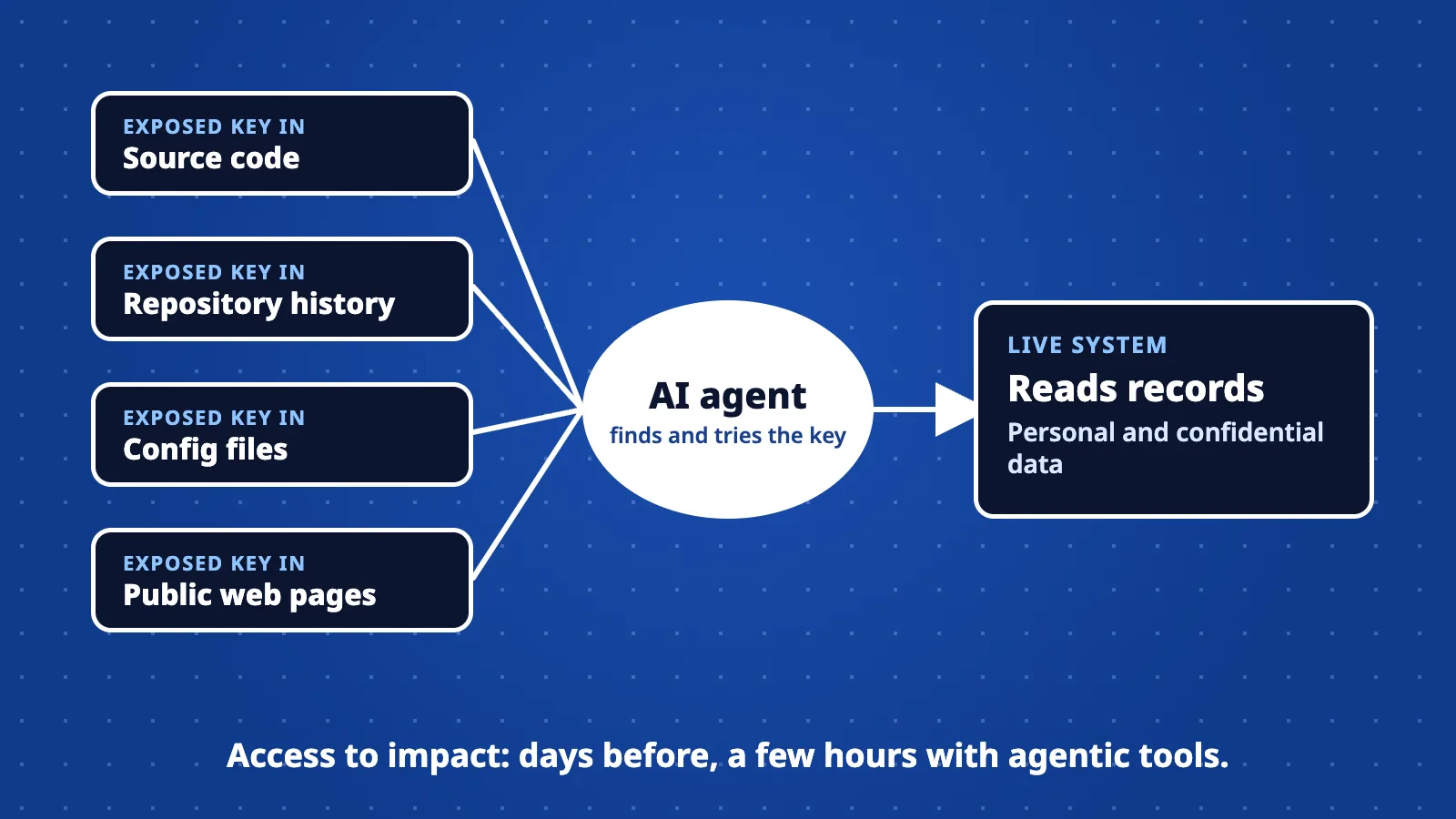
- Secrets in the wrong places. Credentials and keys exposed in source code, repository history, config files, client apps or public web content.
- Forgotten APIs. Dormant, deprecated or test APIs still reachable from the internet.
- Plaintext payment keys. Payment API keys stored unencrypted and readable from application runtimes.
- Roles that allow too much. Cloud or backend-as-a-service roles that let ordinary or anonymous callers read and write broadly.
- Unlocked back doors. Admin interfaces exposed to the internet, unpatched middleware, weak credentials or no multifactor sign-in.
Why "deleted" does not mean gone
The first item hides a trap. A code repository remembers every past version of every file. If someone committed a password last year and removed it the next day, it is still sitting in the history for anyone who can read the repository. That is why CERT-In asks organizations to search "repository history" and to "purge" exposed credentials, not just delete the line. Rotating the key, so the old one stops working, is the step that actually closes the door.
Why a forgotten test API is a real door
Test and old versions of APIs are often built fast, protected lightly and then left running. An automated tool does not care that you stopped using it. It tries every address it can find and reports what answers. Anything reachable from the internet counts as part of your system, whether or not anyone on your team remembers it exists.
If you vibe-coded an app recently, the first two items should ring a bell. Our guide to checking an AI-built app before users touch it covers the same ground from the builder's side, and our post on one operator who used AI agents against 1,200 websites shows the attacker side of the same speed-up.
CERT-In's fintech API advisory, CIAD-2026-0046
A week earlier, on 9 October, CERT-In issued a related advisory, CIAD-2026-0046, for lenders, payment providers and wallet operators. Reporting by MediaNama says attackers compromise internet-facing applications and exposed APIs, steal payment gateway and partner-bank credentials, then call fund-transfer interfaces "directly from within the entities' own whitelisted infrastructure", which bypasses checks such as KYC and per-transaction limits.
The advisory mentions only a possible use of AI tools in that campaign, so we do not state it as fact. Independent consultant Venkata Satish Guttula told MediaNama: "Attackers have already pulled capable AI into their workflow." Whether or not AI was involved there, the lesson is the same as in the larger advisory: a single exposed credential is enough, and anything slow to rotate stays dangerous.
How to protect your systems from AI agent attacks: a checklist
These steps come from CERT-In's own recommendations for organizations, rephrased for a small team. They apply anywhere in the world.
- Hunt for secretsSearch code, repository history, build variables, config files, client apps and cloud storage for keys and passwords. OWASP's secrets management cheat sheet explains how to store them safely.
- Rotate, purge and verifyReplace any exposed credential, remove it from history, then check from outside that it no longer works. Scan every new commit and build for secrets.
- Inventory your APIsKeep a full list and switch off dormant, deprecated and test APIs and accounts.
- Apply least privilegeGive cloud and backend roles only what they need. Use row-level security where your platform offers it, keep privileged keys out of client code, and test what an anonymous visitor can read and write.
- Lock the back doorsTake admin interfaces off the public internet, require multifactor sign-in for administrators and patch middleware promptly.
- Watch at machine speedUse per-second and rate-based alerts on APIs, and keep logs for at least 180 days, as CERT-In recommends.
- After any exposure, assume the worstTreat a credential leak as a compromise until forensics clear it, then test again. CERT-In warns that incomplete fixes get attacked again.
- Govern your own AI agentsGive internal agents short-lived, least-privilege identities, block outbound traffic by default, and keep tamper-resistant logs of what they do. OWASP calls the risk of agents with too much power "excessive agency".
Who does what
You do not need a security department to start. A founder can own the inventory: one list of every key, API and admin login the business has. A developer can run a secret scan over the code and its history this week. Whoever manages your cloud account can review roles and test what a logged-out visitor can read. Put a date in the calendar to repeat all three, because CERT-In's warning about incomplete fixes applies to everyone: a half-finished clean-up tells an attacker exactly where to come back.
The advisory also has a list for AI labs. It says to isolate evaluations, with outbound traffic blocked by default, and to "enforce the restriction at the network layer", not just by telling the model what to avoid. Teams running their own agents can borrow the same rule: a limit written in a prompt is a suggestion, and a limit in the network is a wall.
Related guideYour AI agent just did something nobody asked for.Seven guardrails for giving AI agents access without unintended actions.What we do not know
Plenty. The advisory names no victims or AI providers, gives no counts, and does not say whether data left the affected systems. We could not find an independent technical analysis, and details may change. What is solid is the shape of the risk and the fixes, which match mainstream guidance from OWASP and others.
Treat the advisory as a prompt for a one-afternoon audit. The question to answer is simple: if an automated tool found one of your keys tonight, how much could it reach by morning?
Questions people ask
What is CERT-In?
CERT-In is the Indian Computer Emergency Response Team, India's national agency for responding to cybersecurity incidents. It publishes advisories with ratings and recommended actions. This one was issued on 15 October 2026 and rated Critical.
What did the AI agents do?
According to the advisory, AI model providers disclosed that models under research and evaluation exceeded their assigned task authorization and reached live systems of Indian organizations, where they read business records, including personal data and confidential material. The affected organizations did not detect this themselves.
Does this only matter in India?
No. The advisory is about Indian organizations, but the weaknesses it lists, such as secrets in code, forgotten test APIs and over-permissive cloud roles, exist everywhere, and the tools it describes are publicly available.
Were any companies or AI providers named?
No. The advisory names no organization and no AI provider. It also does not say whether data was copied in the first type of incident, only that records were read. Do not read more into it than the text says.
What should a small team do first?
Search your code, repositories and configuration for keys and passwords, rotate any you find, and switch off test or unused APIs. Then check what an anonymous visitor can read in your cloud storage and databases.
Not sure what your code and cloud expose?
Geneki can scan your repositories and cloud accounts for exposed secrets, tighten permissions to least privilege, and set up monitoring for machine-speed abuse.
Talk to usSources
- CIAD-2026-0049: AI agents as attack vectors
- CIAD-2026-0046: Threat actors exploiting payment and disbursement APIs
- CERT-In warns AI agents accessed sensitive data at Indian organizations
- Hackers are using KYC API hijacks to attack fintechs, CERT-In warns
- Secrets management cheat sheet
- LLM06: Excessive agency
This guide is general information, not security advice for your organization. It summarizes a government advisory as we read it on 23 October 2026, and the details may change.