The short version
- Eight certificates from eMudhra, an Indian certificate authority, had private keys so weak that a researcher recovered them from the public certificates in under a second. A certificate authority is a company your browser trusts to vouch for websites.
- Chrome and Firefox blocked the certificates within hours of the 17 October 2026 report, and eMudhra revoked all eight the next day. No attack using the keys has been confirmed.
- Most visitors are already protected. The people who need to act are website owners whose certificates chain to eMudhra's emSign ECC Root CA G3, and developers whose software ships its own list of trusted authorities.
- You can check in five minutes which authority signs your certificates, and the fix for everything else is the boring one: update.
What happened in the eMudhra certificate compromise
eMudhra is an India-based certificate authority. On 17 October 2026, a security researcher reported that the private keys behind eight of its intermediate certificates were weak. Mozilla's Firefox Security Team says the keys "had been compromised". eMudhra's own statement uses the word "weak". Either way, the practical result is the same: anyone could work out the keys.
How weak? Security researcher Scott Helme, who published an analysis on 20 October, wrote: "One of eMudhra's certificate authority private keys is the number 4." He also said he recovered all eight from the public certificates "on my laptop just now, and it took less than a second." A secret key is meant to be one number out of a space too large to search. These were tiny numbers.
eMudhra says the problem came from an April 2025 key-generation ceremony, that it went undetected for about 18 months, and that the exact root cause is still being investigated. Its statement says: "We acknowledge this incident and take full responsibility for it."
Why this is different from a hack: nobody broke into eMudhra to steal these keys, as far as any source says. The keys were created weak. That is why the researcher could recover them from public files, and why Helme notes that the key "was effectively public from the day the certificate existed."
What is a certificate authority, and why does a weak key matter?
When you visit a site over HTTPS, your browser needs to know it is talking to the real site and not an impostor. It relies on certificates, small signed files that say "this key belongs to this website". A certificate authority (CA) is the organization that signs them. Browser makers and operating system vendors decide which CAs to trust. Mozilla, for example, runs a public program that governs which roots go into its trust store.
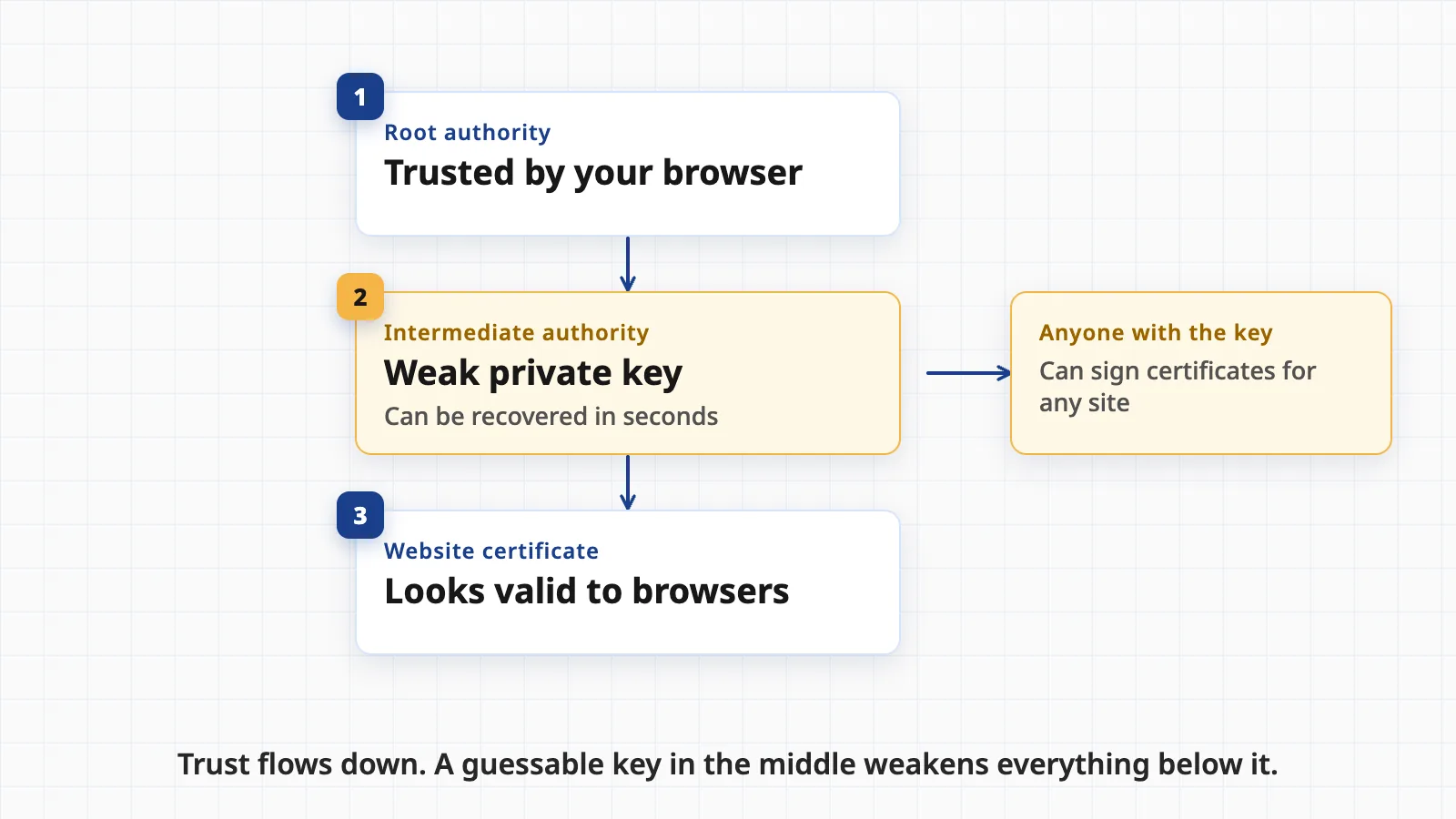
Trust works as a chain. A root certificate sits in your browser. It signs intermediate certificates, and the intermediates sign the certificates that sit on websites. Whoever holds an intermediate's private key can sign certificates that look valid for any website, including one they do not own.
That is the danger here. Mozilla explains that attackers holding the keys could issue fake HTTPS certificates for sites they do not control, letting them impersonate those sites and possibly read or alter traffic during an interception. Cloudflare puts it the same way: "Because the keys themselves are weak, an attacker can create a forged certificate for any domain."
eMudhra certificate compromise: timeline of events
Times are as published by the organizations involved. We found no primary statements from Apple or Microsoft, so we do not give dates for their actions.
- 17 OctoberA researcher reports the issue. Chrome's root program receives the report at 18:05 UTC and, by 19:45 UTC, ships a block to Chrome users that needs no update or restart. Mozilla also receives the report and blocks the certificates through Firefox's revocation list, which reached standard installs within about three hours.
- 18 OctobereMudhra revokes all eight intermediate certificates.
- 19 OctoberAndroid devices receive an equivalent block through a Google Play Services update.
- 20 OctoberMozilla and Cloudflare publish their write-ups. Mozilla removes the root from its trust store and ships Firefox and NSS updates. eMudhra posts its first statement.
- 22 OctobereMudhra offers certificates issued by Sectigo, another authority, as an alternative for all customers.
- 27 October (expected)Google expects to remove the emSign ECC Root CA G3 root from the Chrome Root Store for devices that rely on it. Some legitimate certificates under that root will stop working then.
Who is affected by the eMudhra incident, and who is not
What is confirmed
- No confirmed misuse. eMudhra says it is "not aware of any evidence that the weak keys were recovered or exploited". Cloudflare says its security review "has not identified active exploitation of this issue on Cloudflare services".
- Certificate Transparency saw nothing. Chrome says no certificates chaining to these intermediates were logged to Certificate Transparency before the block. Certificate Transparency is a public log of issued certificates, and Chrome requires it, so a forged certificate that skipped the logs would be rejected by Chrome.
- Browsers are covered. Standard Chrome and Firefox installs received the block automatically.
- Scope. eMudhra says the impact is limited to TLS certificates chaining to the distrusted ECC root, and that one US customer ecosystem is affected. None of the statements we read describes customer data being taken.
What is not settled
- The root cause. eMudhra has not confirmed it.
- The numbers. eMudhra's page speaks of eight affected certificates. Chrome's own post refers to eight in one place and six in another without explaining the difference, so we avoid quoting a single count of affected certificates.
- "No evidence" is not "no attack". Helme points out the keys were effectively public for a long time. The checks that exist, revocation and Certificate Transparency, are strong in browsers and weaker elsewhere.
Where the gap is: software that is not a browser
Helme warns that many non-browser clients, such as command-line tools, programming-language libraries and package managers, may trust these certificates without checking revocation or Certificate Transparency. For them, an attacker "on the network path" is enough, and devices that cannot update their trust list stay exposed. Helme's advice is blunt: "Update everything that ships a CA bundle". He also reports that "a simple prompt in an AI agent allowed me to recover the private keys of the CA", which shows how little effort a check like this now takes. Our guide to the AI-agent campaign against 1,200 websites shows the same trend from the attacker side.
Do not turn off certificate checks to make an error go away. Cloudflare says it plainly: "It's important to not resolve these errors by disabling verification." If something breaks after an update, fix the certificate or the trust list, not the check.
What to check: certificate issuer, browsers and CA bundles
- Update browsers and operating systemsKeep Chrome, Firefox, Android and your computers current. Firefox shipped 158.0.1 and 158.0.2 for Android, and Mozilla also updated its NSS library.
- Find your certificate issuerOpen your site, click the padlock, open the certificate details and read the issuer and chain. Developers can run
openssl s_client -connect yourdomain.com:443 -showcertsto see the whole chain. Look for eMudhra, emSign or a Sectigo cross-sign. - Replace any certificate that chains to emSign ECC Root CA G3Chrome tells site owners to get a new certificate from another authority now, before the root is removed. eMudhra offers Sectigo-issued certificates as an option, and you can choose any other trusted authority.
- Update CA bundles in your softwareUpdate the trust lists in your apps, containers and servers, then rebuild and redeploy. Cloudflare notes that a fix in an SDK may not reach the library that actually checks certificates.
- Test the real pathCheck the trust store your background services use. A browser test may not reflect what a server-side job uses.
- Never disable verificationKeep certificate checks on in every environment, including testing and automation.
- Know what you depend onList every certificate you use and where it lives. If you can swap an authority in hours instead of days, an incident like this stays minor. This part is our advice, not part of the vendors' guidance.
The wider lesson is small and practical: trust on the internet rests on a few organizations getting very ordinary steps right. When one slips, the fix depends on how quickly you can see your own dependencies. Related reading: six cheap habits that block the attacks small businesses actually face, and the longer-term cryptography question in harvest now, decrypt later.
Related guideSix cheap habits that block the attacks small businesses actually faceUpdates, backups and sign-in habits that stop most real-world attacks.Questions people ask
What happened with eMudhra's certificates?
Eight eMudhra intermediate certificate authority certificates were found to have private keys weak enough to be recovered from the public certificates. Chrome and Firefox blocked them within hours of the report on 17 October 2026, eMudhra revoked all eight on 18 October, and Mozilla removed the root they chain to from its trust store.
Do I need to do anything as a regular website visitor?
Keep your browser and operating system updated. Standard Chrome and Firefox installs received the block automatically through their revocation lists, without a restart. Mozilla also shipped Firefox updates, and Google pushed an Android update through Google Play Services.
Does this affect my website?
Only if one of your certificates chains to the emSign ECC Root CA G3 root. Chrome says site owners in that position should get a new certificate from another certificate authority now, because trust in that root is being removed. If your certificates come from another authority, this incident does not by itself require you to replace them, but updating your software is still sensible.
Was anyone attacked with these keys?
No confirmed attack has been reported. eMudhra says it has no evidence the keys were recovered or exploited, Cloudflare says it has not identified active exploitation on its services, and Chrome says no certificates chaining to the eight intermediates were logged to Certificate Transparency before the block. Researchers note the keys were effectively public from the day the certificates were issued, so the absence of evidence is not proof.
How do I find out which authority issued my certificate?
In your browser, click the padlock next to the address, open the certificate details and read the issuer and the chain. Developers can run openssl s_client with the connect option against their domain to list the whole chain. Look for eMudhra, emSign or a Sectigo cross-sign, and ask your host or provider if you are unsure.
Not sure which certificates your sites depend on?
Geneki can inventory every certificate and where it is used, automate renewals, and rehearse swapping a certificate authority so a day like this takes hours, not a scramble.
Talk to usSources
- eMudhra statement on recent certificate security incident
- Protecting Firefox users following the compromise of eMudhra intermediate certificates
- Protecting Chrome and Android users from compromised eMudhra intermediate CA certificates
- 8 eMudhra certificates are compromised. Here's what you need to know
- Eight bits of trust: eMudhra's CA keys cracked in milliseconds
- Mozilla CA Certificate Program
This guide is general information, not security advice for your organization. The incident was still developing when we wrote it: eMudhra has not confirmed the root cause, and platform actions and dates may be updated. Check the linked sources for the latest.