
The short version
- Verizon's 2026 breach report says third parties were involved in 48% of the breaches it studied, up 60% from the year before. A supplier's weak spot can become your breach.
- The best-documented example is the 2025 Salesloft Drift incident: stolen access tokens for one connected app opened data in many companies' Salesforce accounts, without any flaw in Salesforce itself.
- In October 2026 a criminal group named 38 shipping and port organizations as victims. None has publicly confirmed a breach, and the source of the data is unproven. We treat it as a claim, not a fact.
- You do not need a big program. Know which vendors can reach your data, limit what they can touch, and be able to cut them off fast.
How common are third-party breaches? What Verizon's 2026 report says
A third-party breach happens through someone you do business with: a software supplier, an agency, a payment provider, an app connected to your email or CRM. Your own defenses can be solid and you can still be hit, because the attacker walks in through the supplier's door.
Verizon's 2026 Data Breach Investigations Report, covering 1 November 2024 to 31 October 2025, puts a number on it. Its authors write that "breaches with third-party involvement have increased by 60% from last year's dataset, reaching 48% of total breaches." Verizon's measure covers several kinds of supplier relationship, not only software supply chains, so read it as a signal about reliance on suppliers in general.
Verizon also says a good number of the cloud-based third-party incidents it reviewed "boil down to" insecure authentication, such as missing multifactor sign-in or poor credential rotation, or to a lack of least privilege. The same report shows how slowly suppliers fix basics. In its data on third-party cloud exposure, only 23% of third-party organizations fully fixed missing or improperly secured multifactor authentication on their cloud accounts. For weak passwords and permission mistakes, it took almost eight months to resolve half of all findings.
The UK's National Cyber Security Centre (NCSC) makes a similar point about contracts. Its supply chain guidance says "very few UK businesses set minimum security standards for their suppliers". The guidance is written for large organizations and the public sector, but the idea scales down: decide what you expect from a vendor before it has your data.
Salesloft Drift breach: how one app exposed many companies
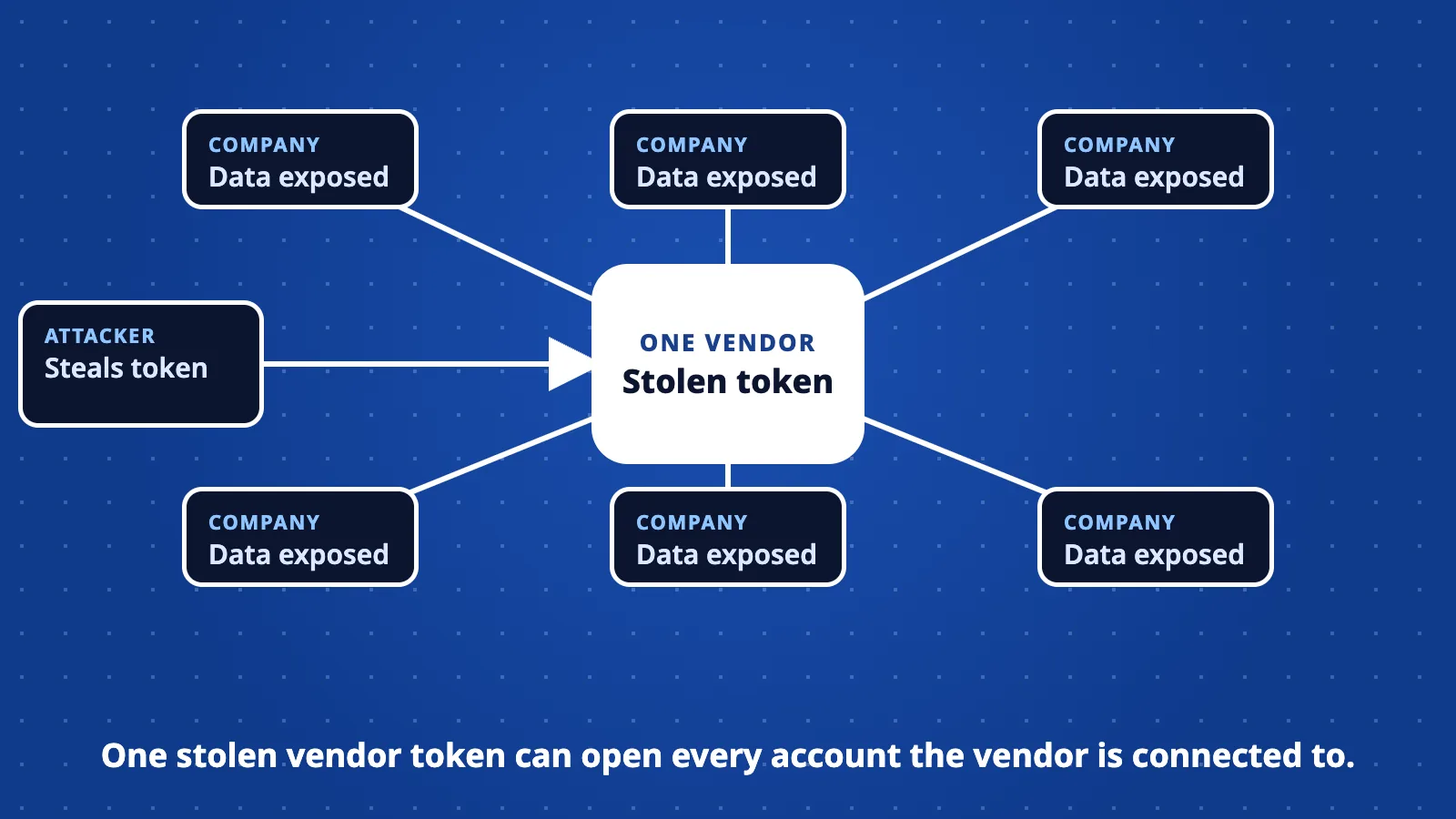
Google Threat Intelligence Group (GTIG) published the clearest documented example, from August 2025. A sales-chat app called Drift, made by Salesloft, was connected to many companies' Salesforce accounts through OAuth tokens. A token works like a spare key: it lets an app act in your account without your password. GTIG reports that an attacker, tracked as UNC6395, stole those tokens and used them to export large amounts of data from numerous corporate Salesforce instances.
- 8 August 2025Earliest activity GTIG saw, using the stolen Drift tokens.
- 9 August 2025In an update, GTIG says Drift Email tokens were also used to reach a very small number of Google Workspace accounts set up to integrate with Drift.
- 18 August 2025Latest activity GTIG saw.
- 20 August 2025Salesloft, working with Salesforce, revoked all active Drift access and refresh tokens.
- 27 and 28 August 2025GTIG publishes its analysis and an update.
Two details matter for a small business. First, GTIG says "this issue does not stem from a vulnerability within the core Salesforce platform". Salesforce was not the weak link. A connected app was. Second, the attacker searched the stolen data for secrets: GTIG saw it hunting for Amazon Web Services access keys, passwords and Snowflake tokens. Data stolen from one tool became a way into others.
GTIG's advice was blunt. It told Drift customers to "treat any and all authentication tokens stored in or connected to the Drift platform as potentially compromised". That is the practical lesson: when a vendor is breached, the questions are which keys it held, and how fast you can rotate them.
Why we use an older case: GTIG gives no total count of victims, and we do not quote the larger figures that circulate online without a primary source. What is documented is enough to learn from.
October 2026 shipping company claims: what is unproven
In October 2026, a criminal group called n0n listed 38 shipping lines, ports and terminal operators on a leak site on 12 October and set a payment deadline a week later, according to The Maritime Executive. The same reporting says none of the 38 organizations has publicly confirmed that its systems were compromised, and that security researchers say the source and extent of the data are unconfirmed. Some analysts suspect the files came from one shared system, but that is a theory, not a finding.
Treat this as developing: outlets disagree on the number of victims and on the ransom amounts, and a listing on a criminal leak site does not prove that a company's own network was breached. We name no vendor, because no source has confirmed one. We will update this guide if that changes.
Whatever the truth turns out to be, the shape is familiar. Many companies in one industry, one common supplier somewhere behind them, and each victim learning of the problem from the news. That is why the checklist below starts with a list of your own suppliers.
Vendor risk checklist: 8 steps for small businesses
These steps follow the NCSC's supply chain principles and the Drift lesson. They are sized for a team without a security department.
- List every vendor that touches your dataInclude apps connected to email, files, your CRM, your cloud and your payments. Mark the ones that hold customer data, money or credentials.
- Set minimum security requirementsPut short, proportionate expectations in every contract: sign-in protection, patching, encryption. Ask vendors to pass them on to their own suppliers.
- Ask for evidence, not promisesA recognized certification, a short questionnaire or a summary of a recent security test is enough for most small suppliers. Check again at renewal.
- Write down incident dutiesAgree how fast a vendor must tell you about a breach and what help you get. NIS2 asks covered EU organizations to think about this for direct suppliers.
- Cut vendor access to the minimumGive each vendor only the permissions it needs, turn on multifactor sign-in, and rotate keys and tokens on a schedule. Verizon's data links many third-party incidents to missing multifactor sign-in and slow fixes.
- Audit connected apps every quarterRemove anything unused. Know where to revoke each app's tokens, and practice it once.
- Plan for a supplier failingKnow your alternatives and keep your own backups of the data you need to keep running. CISA publishes a guide for small and medium-sized businesses on building a supply chain risk plan.
- Watch and reviewSubscribe to vendors' security notices and review the list twice a year. Incidents like Drift are announced by the vendor or researchers first, so someone should read those posts.
Vendor security rules: what NIS2, NCSC and CISA expect
If you operate in the EU in a sector covered by the NIS2 directive, supplier risk is a legal duty. Article 21 lists supply chain security among the measures covered organizations must take, including the security of the relationships with direct suppliers and service providers. It also asks them to weigh each direct supplier's specific weaknesses and cybersecurity practices.
In the UK, the NCSC's supply chain guidance sets out a set of principles for understanding risks, setting controls and checking arrangements, and recommends Cyber Essentials as a baseline for suppliers. In the US, CISA publishes small-business resources for supply chain risk planning. None of these replaces advice for your own situation, but all of them point the same way: know your suppliers, set expectations, check, and be ready to react.
Related reading: six cheap habits that block the attacks small businesses actually face, and how weak links show up in other places, such as the October 2026 eMudhra certificate authority compromise.
Questions people ask
What is a third-party breach?
It is a breach that happens through a supplier, partner or connected service rather than through your own systems. The attacker steals from the vendor, or uses the vendor's access to your data, and you are exposed even though your own defenses held.
How common are third-party breaches?
Verizon's 2026 Data Breach Investigations Report says breaches with third-party involvement increased by 60% from the previous dataset, reaching 48% of the breaches it analyzed. Verizon's measure covers several kinds of supplier relationship, not only software supply chains.
What happened in the Salesloft Drift incident?
Google Threat Intelligence Group reports that an attacker used stolen OAuth tokens for the Salesloft Drift app to export data from numerous corporate Salesforce instances between at least 8 and 18 August 2025. Salesloft and Salesforce revoked all Drift tokens on 20 August. Google says the issue did not stem from a vulnerability in Salesforce's core platform.
Do I need a security questionnaire for every vendor?
No. Start with the vendors that can reach your customer data, your money or your credentials, and ask for proportionate evidence. A one-page questionnaire and a recognized certification are enough for most small suppliers. The UK NCSC recommends proportionate requirements, not a heavy process for every vendor.
What is the fastest single step I can take?
List every app and vendor connected to your email, files, CRM and cloud accounts, remove the ones you no longer use, and make sure you know how to revoke each one's access quickly. Most small businesses find forgotten connections within the first hour.
Want to know which vendors can reach your data?
Geneki can map your integrations, tokens and vendor access, tighten permissions, and set up alerts so a supplier's bad day does not become yours.
Talk to usSources
- 2026 Data Breach Investigations Report
- Widespread data theft targets Salesforce instances via Salesloft Drift
- Supply chain security guidance
- Massive cyber attack threatens release of data from 38 maritime companies
- Empowering small and medium-sized businesses: a resource guide for developing a resilient supply chain risk management plan
- Directive (EU) 2022/2555 (NIS2), Article 21
This guide is general information, not security or legal advice for your organization. The October 2026 claims against shipping and port companies were unconfirmed when we wrote this and may change; the Verizon figure comes from a report with its own methodology.