The short version
- You can test your own visibility this afternoon: 20 questions, five assistants, a four-point score.
- Answers change from one ask to the next, so run each question a few times and look at the pattern.
- If you are missing, check crawler access first, then clear facts on your site and mentions elsewhere.
- No one can promise a placement, and no vendor documentation says otherwise.
Why check by hand
Our earlier guides cover how to get cited by AI search and a checklist for your website. Both are about what to build. This one is about what to measure first, because you cannot judge any of that work without a starting point.
The test is simple. Ask the assistants what your customers would ask, and write down what comes back. A dental clinic in Columbus, Ohio might ask "Which dentists near Columbus take new patients on weekends?" A Manchester accountant might ask "Who can help a small online shop with VAT?" What the assistants say is what a growing share of your customers see.
Two honest cautions before you start. First, nobody can guarantee placement in these answers. Google's own page says there are no additional requirements to appear in AI Overviews or AI Mode beyond being indexed and eligible to show a snippet, and it promises nothing more. Second, the measurement is noisy. Microsoft's Azure OpenAI documentation puts it plainly: if you ask a model the same question several times, you are likely to get a different response. Treat each answer as one sample.
The 20 questions
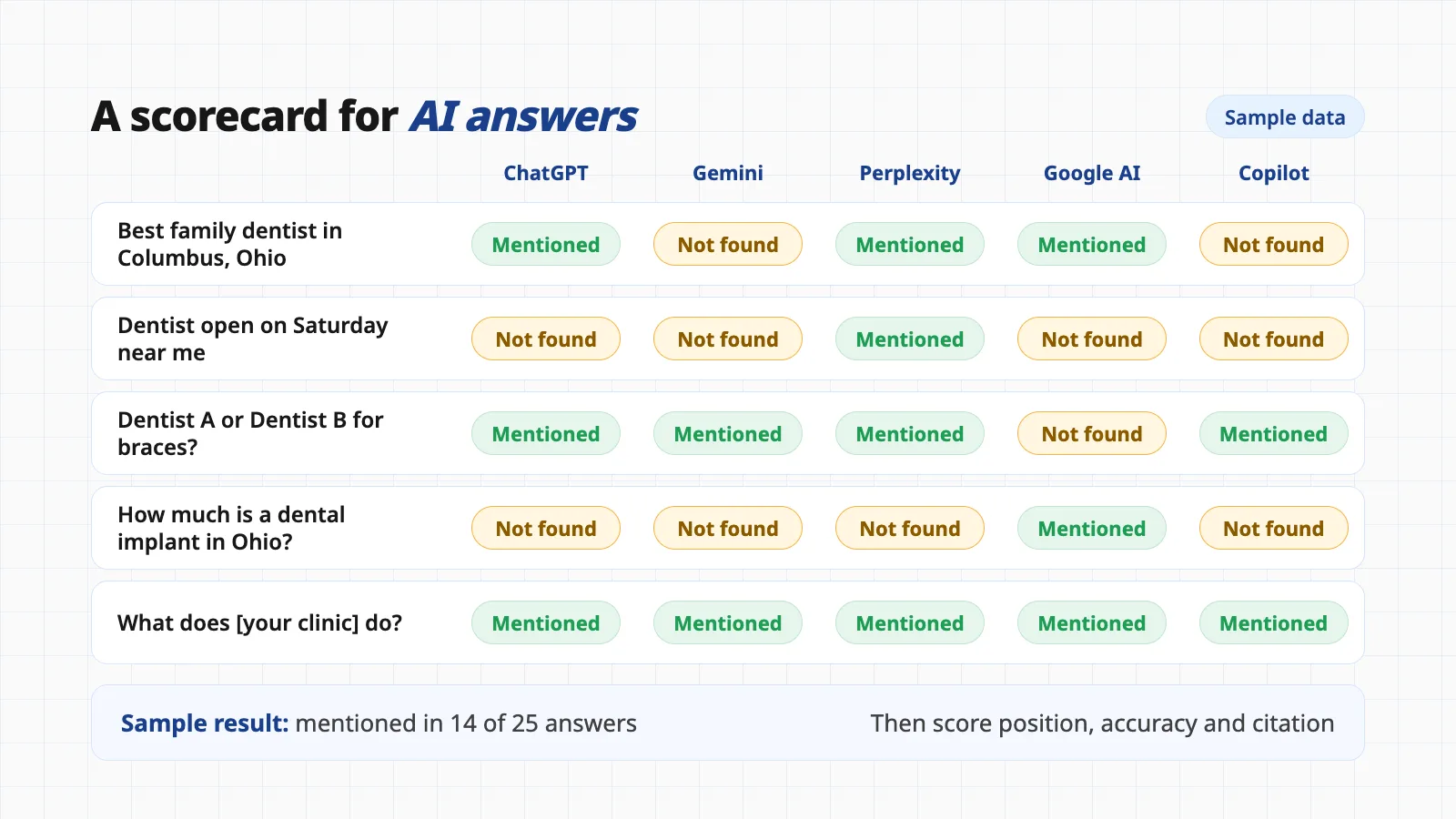
Write them the way customers talk, not the way your website does. Use five kinds of question, four of each. Here is a template, with the Ohio dental clinic as the example.
- Find me one (4 questions)"Best family dentist in Columbus, Ohio." "Dentist near me open on Saturday." Include your area and your main service.
- Compare (4 questions)"Dentist A or Dentist B for braces?" Use your real competitors by name, and also the generic "X vs Y" questions your customers ask.
- Price and process (4 questions)"How much does a dental implant cost in Ohio?" "How long does a root canal take?" Assistants often name providers when they answer these.
- Trust and problems (4 questions)"Is [your business] any good?" "Are there complaints about [your business]?" "How do I choose a dentist?"
- Your name (4 questions)"What does [your business] do?" "Where is [your business] and what are its hours?" This is where wrong details show up fastest.
Get the wording from real life: your search queries, the questions your front desk answers every week, the phrases in your reviews. Keep the list fixed, so you can compare month to month.
Run the test
Use five places where customers now get answers. Each has a slightly different way of working, so keep notes of what you used.
- ChatGPT. Start a new chat for each question with search on, so it can use the web. A fresh chat avoids earlier conversation shaping the answer.
- Gemini. The same method. Google documents that its Gemini apps can use content from Google Search to ground answers.
- Perplexity. It shows its sources by default, which makes the citation score easy.
- Google AI Overviews and AI Mode. Search the question on Google in a private window. An AI Overview does not appear for every search, so write "none shown" when it does not. Try AI Mode on the same question. Google says both can run multiple related searches across subtopics to build a response, so they may link to a wider set of pages than a classic search.
- Microsoft Copilot. Ask in a new conversation. Microsoft's Bing Webmaster Tools also has an AI Performance report, in public preview since February 2026, that counts how often your pages are cited as sources in Copilot and Bing's AI summaries. That is a rare case of a vendor giving you your own numbers.
Keep it comparable. Ask from a signed-out or private session where you can, note your city and the date, and paste the answer into a spreadsheet. Assistants may personalize results by location or history, so two people can see different answers. That is another reason to treat results as a pattern, not a verdict.
Twenty questions across five assistants is 100 answers. That is a long afternoon, which is why many people start with the "find me one" and "your name" groups.
Score and repeat
For every answer, ask four things. Give one point for each yes, so each answer scores 0 to 4.
- MentionIs your business named at all? This is the first gate. If not, nothing else matters for that question.
- PositionAre you among the first three named? Assistants usually list a handful of options, and people rarely go further.
- AccuracyAre the name, address, hours, prices and services right? A wrong phone number or an old price counts as a no, and it is the most useful thing to fix.
- CitationDoes the answer link to your own website? A mention without a link still builds awareness, but a link sends visitors.
Add the points per assistant and per question group. You will quickly see a pattern: perhaps you are named for your branded questions but absent from "find me one", or Perplexity cites you and Gemini does not. That tells you where to look.
How often to repeat
Because answers vary, one run proves little. A practical rhythm:
- First roundAsk each question three times, on three different days. Count a mention only if you see it in at least two of three, and note when you appear only once.
- After a changeRepeat after you fix a robots.txt rule or publish an important page. OpenAI and Perplexity say crawler changes can take about 24 hours to apply, and content changes can take much longer. No company publishes a timeline.
- MonthlyRun the full list again and compare totals with last month.
What to fix
Start with whatever your scorecard shows. Here is the order we would work in. None of it guarantees a result.
1. Crawler access
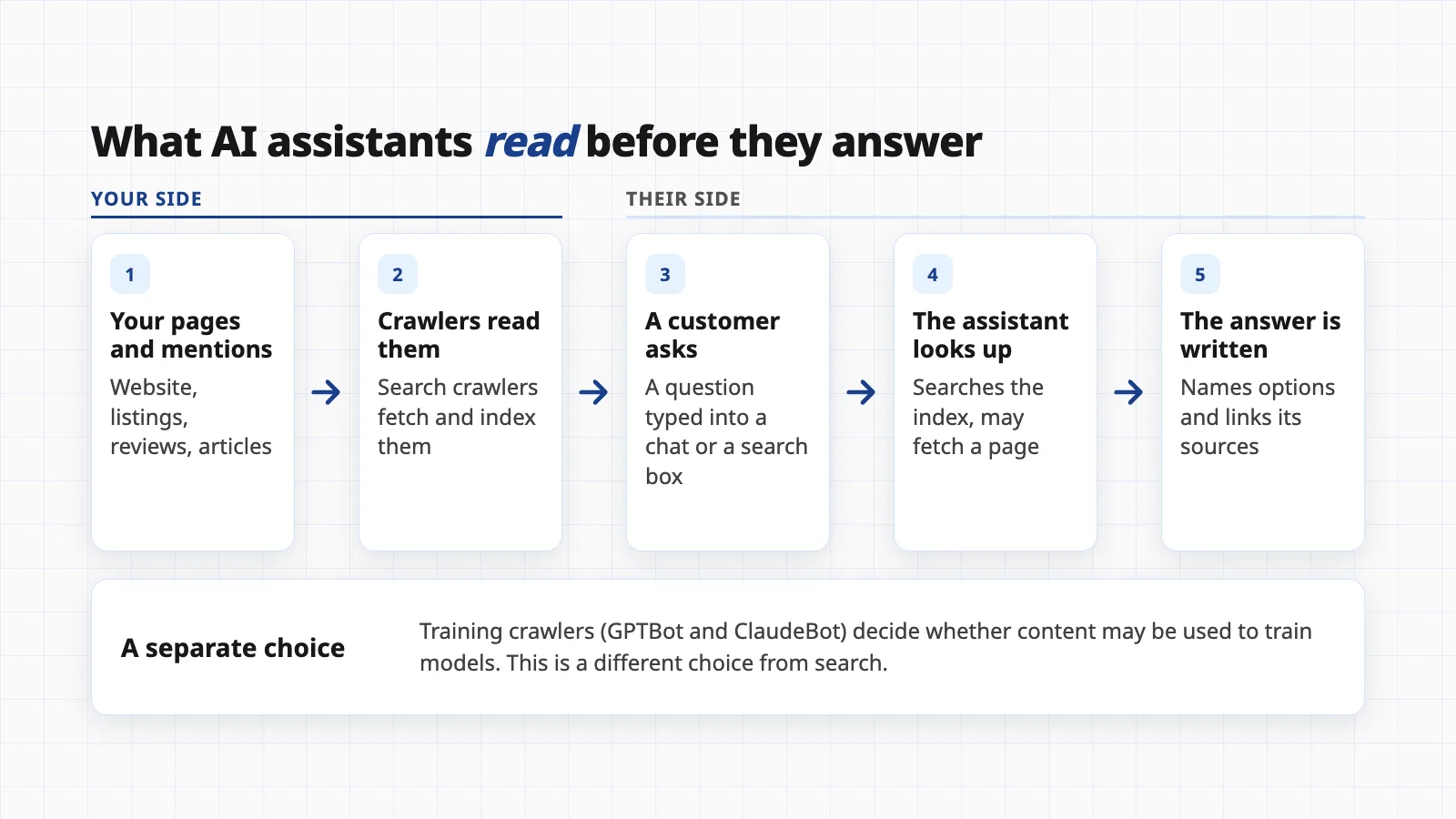
If you appear nowhere, make sure the bots that feed search answers are not blocked in your robots.txt (a plain text file at the root of your site that tells crawlers what they may read). The companies separate bots by job, so blocking one does not block the others:
- OpenAI. OAI-SearchBot is for search and surfaces sites in ChatGPT's search features. GPTBot is for training. ChatGPT-User visits pages when a person asks, and OpenAI says robots.txt rules may not apply to it. Opting out of OAI-SearchBot keeps you out of ChatGPT search answers, though you can still appear as a navigational link.
- Perplexity. PerplexityBot surfaces and links sites in Perplexity results and is not used for training. Perplexity-User fetches pages when a person asks and generally ignores robots.txt.
- Anthropic. ClaudeBot collects content that could contribute to training. Claude-SearchBot improves the quality of search results, and Claude-User fetches pages when a Claude user asks. Anthropic says disabling the last two may reduce your visibility.
- Google. No special bot for AI Overviews or AI Mode: the page must be indexed and eligible to show a snippet. Google-Extended is a robots.txt token that governs use for Gemini training and for grounding in Gemini apps. It does not affect inclusion in Google Search.
- Microsoft. Bing says it respects robots.txt preferences. Its AI Performance report is where you check Copilot citations.
Whether to allow training bots is a separate business decision. OpenAI and Anthropic each list their training and search bots separately, so you can treat them differently. Also check your hosting or CDN is not blocking crawlers by default. Our website checklist goes through this in more detail.
2. Answers on your own site
If you appear but with wrong details, fix the source. Put your address, hours, prices and services as plain text on the page, not only in images or PDFs. Google says no special markup is needed for AI features, but structured data is fine as long as it matches what visitors can see.
3. Consistent details everywhere
Bing's guidance says to keep text, images and video consistent about the same products or concepts, and local businesses can keep address, hours and contact details current through Bing Places for Business. Do the same on your Google Business Profile, directories and social pages. Mismatched details across the web are a likely source of wrong answers, though no vendor has said how much weight any one source gets.
4. Mentions elsewhere
Assistants that search the web draw on more than your site. Reviews, local directories, industry roundups and partner pages are places where a customer's answer may come from. This is a sensible bet rather than a documented formula, so treat it as that.
5. llms.txt
llmstxt.org describes it as a proposed Markdown file that gives AI agents a short guide to your site. It remains a proposal, and Google's guidance says Search does not need new machine-readable files. It is cheap to add and unproven. Do it last, if at all.
Beware promises. Anyone who guarantees you a place in ChatGPT or Gemini answers is promising something no company documents. Use any tool, including ours, to measure and prioritize, not to buy a ranking.
Doing this at scale
The manual test works well for one business and a few dozen questions. It gets tedious when you track competitors, run questions repeatedly or want a trend line. That is the problem Statbricks is meant to solve. It is our tool in development: it chooses the questions your customers ask in your market, samples the assistants' answers repeatedly so scores are steadier than a single reading, and lists the content changes to make first. It is not live yet and the waitlist is open.
Until then, the spreadsheet above does the same job by hand. Run it once this week, fix the single biggest gap, and run it again next month.
Questions people ask
How do I check if ChatGPT mentions my business?
Ask it the questions your customers ask, such as the best provider of your service in your area, in a fresh chat with search turned on. Note whether you are named, in what position, whether the details are right and whether your site is linked. Repeat on different days because answers vary.
Can I pay or submit my site to appear in AI answers?
Not directly. Google says there are no additional requirements to appear in AI Overviews or AI Mode beyond being indexed and eligible to show a snippet. The other companies document crawlers you can allow, but none of the documentation we read promises placement.
Should I block GPTBot, ClaudeBot or Google-Extended?
Those are about training, which is a separate decision from appearing in search answers. OpenAI says GPTBot is for training and OAI-SearchBot is for search. Anthropic says ClaudeBot collects content that could contribute to training. Google says Google-Extended does not affect inclusion in Google Search, but note it also covers grounding in Gemini apps, so read Google's page before blocking it.
How often should I repeat the test?
Run each question three times in your first round, on different days, then repeat monthly and after any big content or robots.txt change. OpenAI and Perplexity both say crawler setting changes can take about 24 hours to apply. Content changes can take longer, and no company publishes a timeline.
Do I need an llms.txt file?
It is cheap but unproven. llmstxt.org describes it as a proposal, and Google's guidance says it does not need new machine-readable files for Search. Add one if you like, but do not expect it to change your results.
Want this measured for you?
Statbricks is our tool in development that tracks where your business shows up in AI assistants' answers and what to fix. It is not live yet. Join the waitlist to be in the first group.
Join the waitlistSources
- AI features and your website
- Google's common crawlers (Google-Extended)
- Overview of OpenAI crawlers
- Perplexity crawlers
- Does Anthropic crawl data from the web, and how can site owners block the crawler?
- Introducing AI Performance in Bing Webmaster Tools (public preview)
- How to generate reproducible output with Azure OpenAI
- The /llms.txt file proposal
- Our guide: how to get your business cited by AI search
- Our checklist: does your website show up when people ask AI?
Nobody can guarantee a place in an AI assistant's answers, and measuring it is noisy. Assistants change often and personalize results, so treat any single reading as a sample. Crawler names and behavior come from each company's own documentation as read in November 2026 and may change. The scorecard image uses made-up sample data.