
The short version
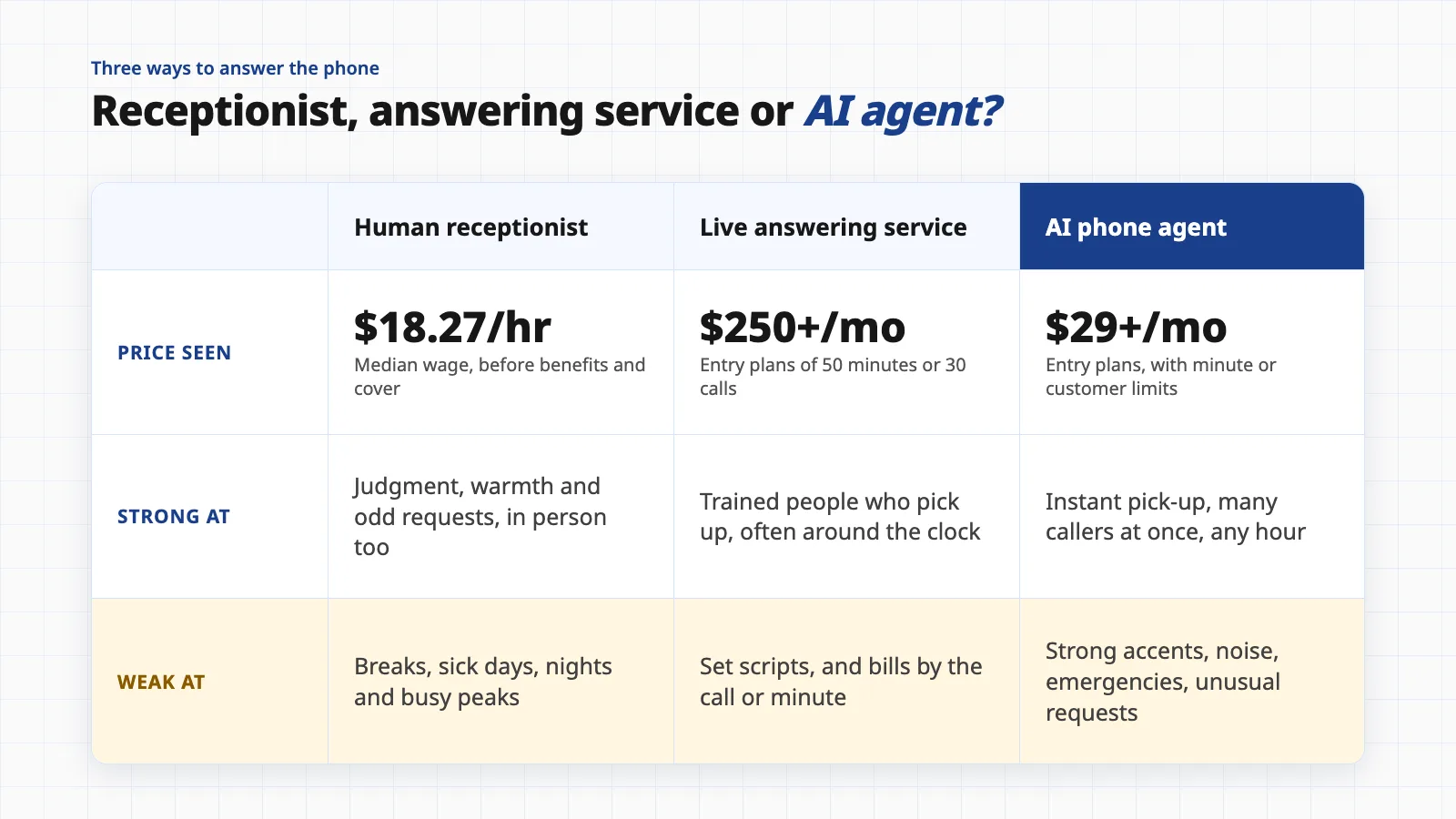
- Public AI receptionist plans start around $29 to $79 a month. Live answering services start around $250 to $300. A receptionist's median US wage is $18.27 an hour.
- An AI agent is good at repeatable calls: answer, ask your questions, book, pass on. It is weaker with strong accents, noisy lines, upset callers and emergencies.
- The deciding feature is the hand-off: when and how does a call reach a person, and what do they know when it does?
- Test with your own callers before you go live, and check the rules on disclosing AI.
What it costs
Prices below are the public list prices on each vendor's own pricing page, checked on 7 November 2026. They change often, they are not quotes, and plans measure different things: minutes, calls or unique customers. We have not tested these vendors and do not recommend one. Many vendors, including some serious ones, publish no prices at all.
| Option | What the public page lists |
|---|---|
| AI receptionist, Dialzara | $29 a month for 60 minutes up to $349 a month for 1,000 minutes; extra minutes $0.35 to $0.48. A done-for-you tier starts at $1,500 a month. |
| AI receptionist, Goodcall | $79 a month for 100 unique customers, $129 for 500, $299 for 2,000. No per-minute charge. |
| AI receptionist, Smith.ai | A free plan with 25 calls a month, then $3.00 a call; $150 and $500 a month plans with lower per-call rates. |
| Build your own, Retell AI | $0.07 to $0.31 a minute for the voice agent, plus telephony and add-ons. This is a developer platform, not a ready-made receptionist. |
| Live answering, Ruby | $250 a month for 50 minutes, $395 for 100, $720 for 200, $1,725 for 500. |
| Live answering, Smith.ai | $300 a month for 30 calls, $810 for 90, $2,100 for 300; extra calls $8.50 to $11.50. |
| A human receptionist | Median US wage $18.27 an hour, $38,010 a year (May 2025, US Bureau of Labor Statistics). Wages only: add payroll tax, benefits, cover for breaks and holidays. |
The same volume, three ways (illustrative arithmetic)
Take 100 calls a month averaging three minutes, so 300 minutes. This is our arithmetic from the list prices above, not a quote, and a "minute" is counted differently by each vendor.
- Dialzara's $99 plan covers 220 minutes; the extra 80 at $0.45 add $36, so about $135 a month.
- Smith.ai's live-staffed $810 plan covers 90 calls; 10 more at $10.50 add $105, so about $915 a month.
- Ruby's 500-minute plan at $1,725 is the smallest listed that covers 300 minutes. Ruby lists no overage rate, so what happens when you exceed a smaller plan is a question to ask.
The gap is large, but cheap is not the same as right. A cheaper plan that mishandles the calls that matter costs more than it saves. Also count your own setup time, any phone or calendar integration fees and what happens when you go over your allowance.
VeloVoice pricing is agreed on a short call, because it depends on your call volume and the tools you use. We do not publish a figure here.
What it can and cannot do today
An AI phone agent listens to the caller, turns speech into text, decides what to say using a language model and speaks the answer back. It can usually do these well when you set it up properly:
- Answer. Pick up at any hour, even when several people call at once.
- Answer common questions. Hours, service areas, prices you have approved, how to prepare for a visit.
- Qualify. Ask your questions: who is calling, what they need, where, how urgent.
- Book. Check a connected calendar, offer a time and confirm it by text.
- Hand off. Transfer the call or pass the details to a person.
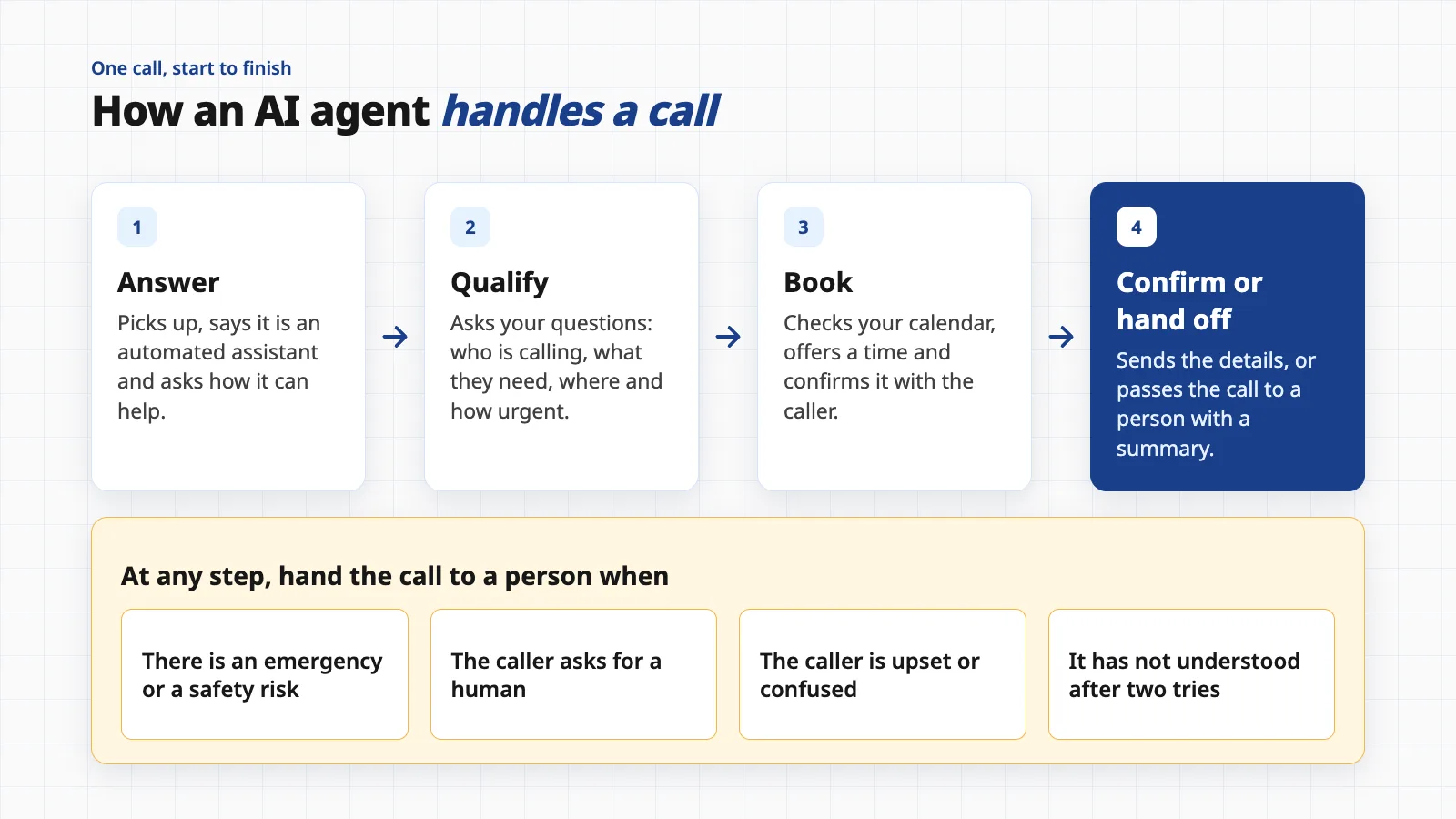
And these are the limits we would plan around:
- Accents and dialects. A peer-reviewed 2020 study in PNAS tested five commercial speech-recognition systems and found much higher error rates for Black speakers than white speakers, a gap the authors traced to the underlying models. Newer systems have improved, but the lesson stands: test with your real callers.
- Noise. A caller on a building site, a motorway or a speakerphone is harder to understand. Ask how the agent behaves when it cannot make out a word.
- Emergencies. A gas smell, a flooding ceiling, a dental trauma, a threat of harm. These must reach a person or emergency services quickly. Do not rely on a model to judge it unaided.
- Upset or confused callers. A person who is angry, grieving or frightened wants a human, and an AI that carries on can make things worse.
- Judgment and advice. Quotes that depend on a site visit, medical or legal advice, exceptions to your policy. The agent should say it cannot help and offer a human.
- Making things up. Language models can state wrong facts confidently. Limit it to answers you have given it, and review transcripts.
Know the rules. In the United States, the FCC ruled in February 2024 that AI-generated voices are artificial voices under the TCPA, so many outbound calls using them need the recipient's prior consent. In the EU, the AI Act requires systems that talk to people to say they are AI unless it is obvious; our guide to the EU AI Act and GDPR explains it. Call-recording rules also vary by country and US state. Take advice for your own situation.
Receptionist, answering service or AI?
| Human receptionist | Live answering service | AI phone agent | |
|---|---|---|---|
| Best for | Judgment, a warm welcome, callers who walk in too | Overflow, nights and weekends with trained people | Repeatable calls at any hour and many at once |
| Weak at | Breaks, sick days, busy peaks, nights | Set scripts and per-call or per-minute bills | Accents, noise, emergencies, unusual requests |
| Cost shape | Wages plus cover | Monthly plan by calls or minutes | Monthly plan by minutes, calls or customers |
| Knows your business | Learns over time | Follows the notes you give | Knows what you configure and connect |
Most small businesses do not choose one. A person covers office hours, an answering service or an AI agent catches overflow and nights, and every route ends at a person for the calls that matter. If you are not sure how many calls you actually miss, start with our guide to counting missed calls and use your own log to decide.
Related guideYour phone rang out. What did it cost you?A fact-checked look at missed-call numbers and a way to count your own.Questions to ask a vendor
- 1. What exactly does one unit cost?Is it a minute, a call or a unique customer? What happens at the limit, and are spam calls and wrong numbers counted?
- 2. Can I hear real calls?Ask for recordings from a business like yours, not a polished demo. Better, call the demo line yourself from a noisy place.
- 3. How does it behave when it does not understand?Does it ask again, offer a text, or pass to a person? How many tries?
- 4. How does the hand-off work?Warm transfer with a summary, a message to a named person, or only a voicemail? What if nobody picks up?
- 5. How are emergencies handled?Which words trigger it, what is said to the caller, who is rung and how fast? Ask to test it.
- 6. Does it say it is an AI?And can you set the wording to match your local rules?
- 7. Where do recordings and transcripts live?Who can read them, how long are they kept, and can you delete them? Does it comply with the privacy law that applies to your callers?
- 8. Which tools does it connect to?Your calendar, CRM and phone system. Is each one included, or an extra?
- 9. Who sets it up and who fixes it?Self-serve, or does a person configure and support it? What does a bad call cost you in support time?
- 10. What is the exit?Contract length, notice period, and whether you keep your number.
A hand-off checklist
The hand-off is the part that decides whether an AI receptionist helps or hurts. This list is our own, drawn from the limits above. Settle each point in writing before launch.
- Triggers are written downEmergency words, "speak to a person", anger or distress, two failed attempts to understand, and any topic you never want an AI to handle.
- A named human receives each hand-offWith a phone number that is answered, and a second person if the first does not pick up.
- The human gets a summaryCaller name, number, what they asked and what was already said, so nobody repeats themselves.
- There is an out-of-hours planIf no one is available, the caller hears what will happen next and when, and a message is sent to you straight away.
- The emergency script is testedCall it yourself. Check that it points to emergency services where life or safety is at risk.
- Disclosure and consent are settledThe opening line says it is an automated assistant where required, and recording notices match local law.
- You review real calls weekly at firstListen to a sample, especially the failures, and fix the script. Check accents, noise and the calls that went to voicemail.
If you want to try this with an assistant that is already running, VeloVoice was built for trades, clinics, brokers and law firms. We configure the rules, including what goes to a person, test it with you and support it afterwards. Bring your hand-off checklist to the demo and see how each point would be handled.
Related guideYour AI agent just did something nobody asked for.Seven guardrails to put in place before an agent touches a real system.Questions people ask
How much does an AI receptionist cost?
Public entry plans we found on 7 November 2026 ranged from $29 a month (Dialzara, 60 minutes) and $79 a month (Goodcall, 100 unique customers) up to a few hundred dollars for higher volumes, with managed, done-for-you setups starting at $1,500 a month at one vendor. Platforms for building your own voice agent charge about $0.07 to $0.31 a minute. Prices change often, so check each page.
Can an AI receptionist replace a human receptionist?
For repeatable calls such as hours, prices, directions and booking, it can take much of the load. For judgment, upset callers, emergencies and anything unusual, you still need a person. Most businesses use it to cover nights, busy peaks and calls they would otherwise miss, not to remove people.
Does an AI receptionist understand accents and noisy lines?
Less reliably than a person. A 2020 PNAS study of five commercial speech-recognition systems found much higher error rates for Black speakers than white speakers. Systems have improved since, but you should test any vendor with your own callers, accents and background noise.
Do I have to tell callers it is an AI?
Often yes, and it is good practice everywhere. The EU AI Act requires systems that talk to people to disclose that they are AI unless it is obvious. In the United States, the FCC ruled in February 2024 that AI-generated voices count as artificial voices under the TCPA, which requires prior consent for many outbound calls. Take advice for your own situation.
What should happen in an emergency?
The assistant should not try to handle it. It should recognize your emergency words, tell the caller to contact emergency services if life or safety is at risk, and pass the call to a named person at once. Test this before you go live.
Want to hear it handle a call for your business?
VeloVoice answers calls, deals with common questions and books the appointment in your calendar, with rules you set for what goes to a person. We set it up and support it. Pricing is agreed on a short call.
See VeloVoiceSources
- Plans and pricing: virtual front desk (live receptionists)
- AI receptionist plans
- Pricing
- Pricing
- Pricing for virtual receptionists
- Pricing for AI voice agents
- Receptionists: occupational outlook handbook
- Racial disparities in automated speech recognition
- FCC makes AI-generated voices in robocalls illegal
Prices are public list prices checked on 7 November 2026 and change often. They are not quotes, plans differ in what counts as a minute or a call, and we have not tested these vendors. This is general information, not legal advice; rules on AI disclosure, call recording and automated calls vary by country and state.