The short version
- A missed call can send the caller straight to the next business on their list, so it is worth knowing how many you miss.
- The famous figures, such as "$126,000 a year lost", trace only to vendor blogs. We have left them out or labeled them.
- Count your own: two weeks of your phone log is enough to put a real dollar value on the calls you missed.
- Fix the pattern you find: staff, an answering service, faster follow-up, or an AI voice assistant, with a human for anything sensitive.
Why a missed call is different
A burst pipe, a cracked tooth, a mortgage rate that closes on Friday, a landlord threatening court. People in these moments do not browse. They ring, and if nobody picks up, many of them ring the next name on the list.
That is why phone calls matter more than most inbound contact for trades, clinics, brokers and law firms. A web form can wait until tomorrow. A person with a leak cannot.
How often do calls go unanswered? Two measured examples, both with limits:
- Invoca, July 2026. The call-tracking company analyzed more than 70 million calls to businesses on its platform across 10 industries and reports that 56% of callers speak with a person. This is a vendor's data on calls tracked on its platform, not a census of all small businesses.
- Clio, 2024. The legal software company ran a secret-shopper test and found that 40% of law firms answered the phone, down from 56% in its 2019 test. It is a test of one profession.
Neither number is "your" number. Yours depends on your hours, your trade and whether you are on a roof or in a surgery when the phone goes.
How fast leads go cold
The best-known research on speed is about online enquiries, not phone calls. In 2007 InsideSales.com, a sales software company, and James Oldroyd of MIT Sloan presented a study of web-form leads at six companies: three years of data, over 15,000 leads and more than 100,000 call attempts. They reported that the odds of reaching a lead fell more than ten times in the first hour, and that calling at 30 minutes rather than 5 minutes cut the odds of reaching the lead by about 100 times and of qualifying it by about 21 times.
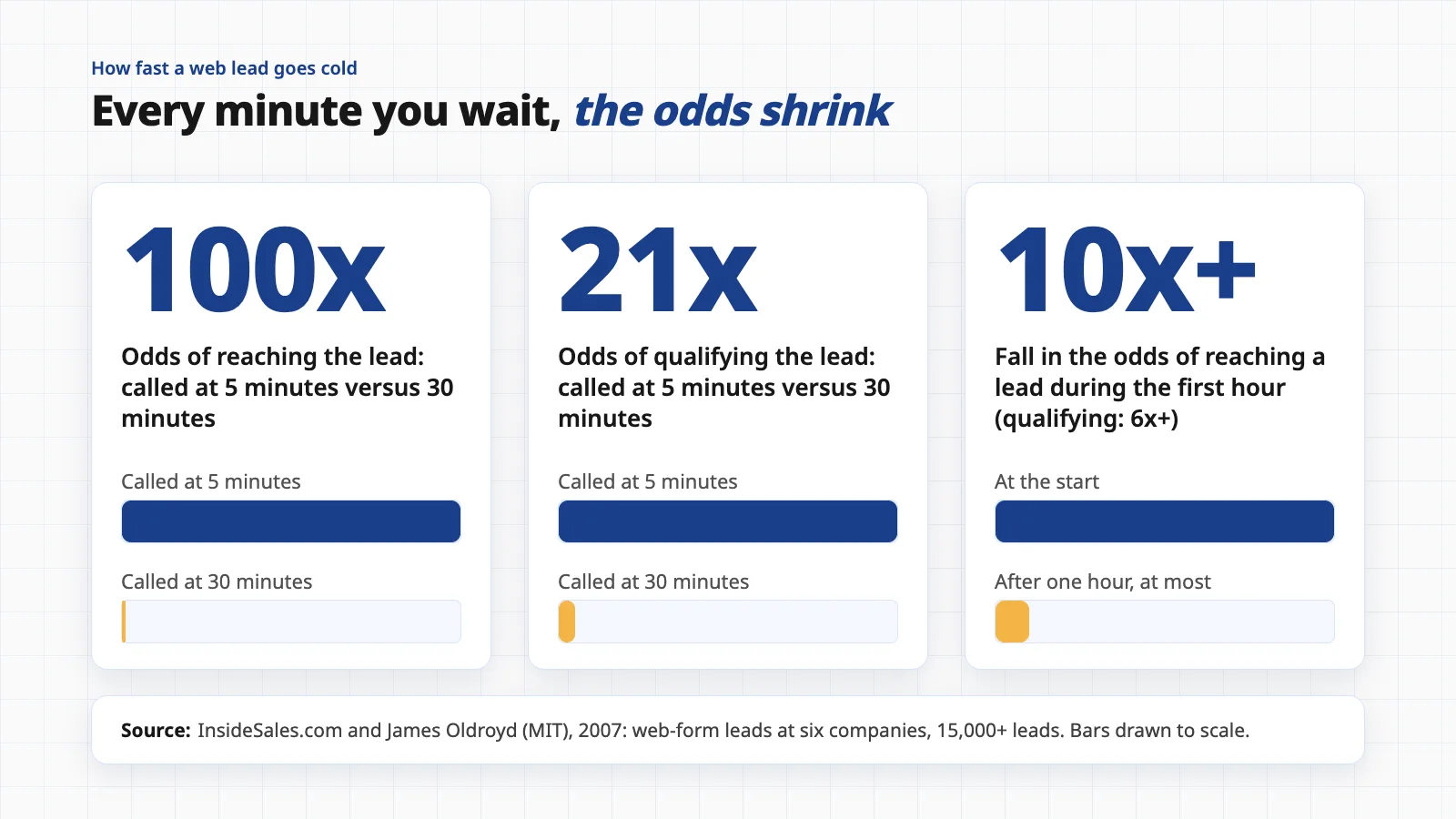
Handle this with care. It is a 2007 industry presentation, not a peer-reviewed paper, it is about online forms rather than inbound phone calls. A later Harvard Business Review article by the same lead researcher with two co-authors, in March 2011, reached a milder conclusion that is easy to defend: most companies are not responding nearly fast enough.
What to take from it. Speed matters, and the first minutes matter most. The exact multiples depend on the business and the kind of lead. For a phone call the window is even shorter, because the caller is still holding the phone.
The numbers you have seen online
Search for missed call statistics and you will find the same handful of figures on dozens of vendor pages. We traced each one.
| Figure | What we found |
|---|---|
| "62% of small business calls go unanswered" | Usually credited to a study of 85 businesses by 411 Locals, an answering service. Pages disagree on its date (2016 and 2024 both appear), and we could not find the original report. Vendor-reported, and a small sample. |
| "85% of callers who reach voicemail never call back" | Pages attribute it to an answering service (PATLive) or to each other. We could not trace it to a primary study. Vendor-reported. |
| "$126,000 a year lost to missed calls" | One vendor page calls it an estimate from a call center and does not show the working. Its inputs are assumptions. We have not repeated it. |
| "Respond within 5 minutes" | Traces to the 2007 InsideSales.com and MIT study of web leads, described above. Real, but dated, vendor-sponsored and about forms. |
| 56% of callers reach a person | Invoca's 2026 benchmark of its own customers' calls. A measured figure from a vendor, with a large sample. |
| 40% of law firms answered the phone | Clio's 2024 secret-shopper test, down from 56% in 2019. A measured figure for one profession. |
Why this matters. The scariest numbers are written by companies that sell the fix. That does not make the problem fake. It means you should measure it yourself before you spend anything.
Count your own missed calls
You need your phone log and about an hour. Pull the last two weeks from your phone provider's dashboard, your business line's app or your mobile's call history. Then:
- 1. List every inbound callOne row per call: date, time, answered or missed, and whether the caller left a voicemail.
- 2. Remove the noiseStrike out spam, wrong numbers and existing customers who will reach you anyway. What is left is real new enquiries.
- 3. Note the time of dayLook for clusters: lunch, while you are on a job, after 5 pm, weekends. The pattern tells you which fix suits you.
- 4. Track the callbackFor each missed new enquiry, write down how long it took you to ring back and whether you reached them. Callers you recovered are not lost.
- 5. Find your own booking rateOf the new enquiries you did answer, how many became jobs? That number, not an internet average, is what a missed call was worth.
A worked example (illustrative numbers)
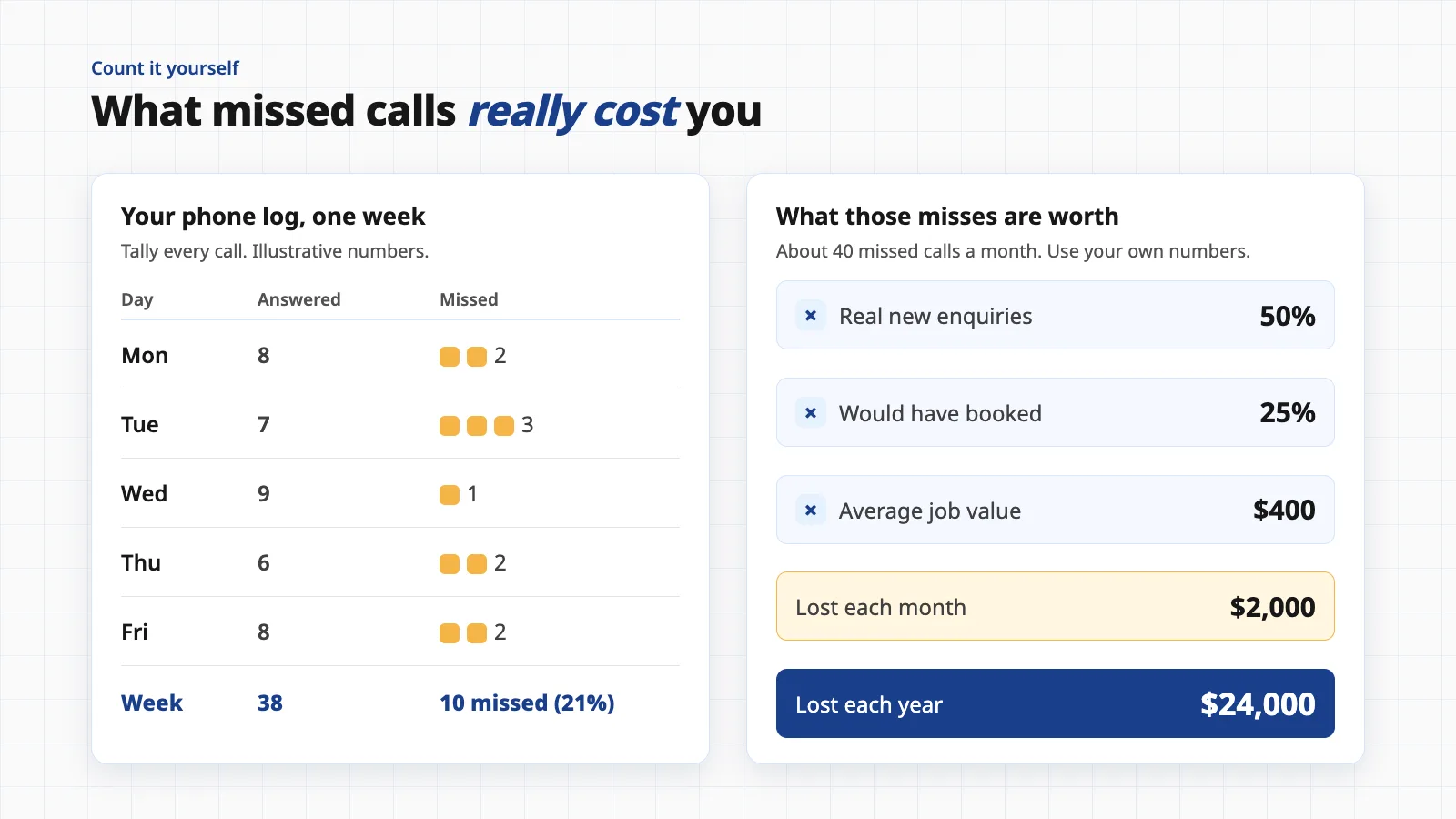
Say a plumber in Columbus, Ohio, logs 48 calls in a week and misses 10, so about 40 a month. Half of the missed calls are real new enquiries. In the answered calls, one in four new enquiries becomes a booked job. The average job is $400.
- 40 missed calls a month, times 50% real new enquiries, is 20 callers.
- 20 callers, times 25% who would have booked, is 5 jobs.
- 5 jobs, times $400, is $2,000 a month, or about $24,000 a year.
Now subtract the ones you recover. If you ring back and win a quarter of those 5 jobs, the true loss is smaller. That is the honest number. Your inputs will be different, and some trades have a job value of $50 while others, like a mortgage or a legal matter, are worth thousands. That is why a plumber's $24,000 tells you nothing about a dental clinic's figure.
Do not forget the quiet cost. A missed call from an existing customer, a patient with a question or a client chasing an update may not lose a sale, but it costs goodwill. It is harder to count, so note it in the log without a dollar value.
Five ways to fix it
Read your log first. Then pick the option that fits the pattern.
| Option | Fits when | Watch out for |
|---|---|---|
| Add staff or shared cover | Misses cluster in office hours and the calls need judgment. | Salary, holidays and sick days. Peaks still overwhelm one person. |
| Live answering service | Misses happen at night, at weekends or during busy spells. | Billed per call or per minute. Staff follow a script and may not know your business deeply. |
| Voicemail with a promise | Volume is low and you can reliably ring back. | Many callers will not leave a message. Speed of your callback is what counts. |
| Text-back and follow-up | Callers leave a number but expect an answer fast. | A text is not a conversation. Check the rules on messaging in your country. |
| AI voice assistant | You miss calls on jobs, at night or at peaks and your calls are fairly repeatable: prices, hours, booking. | Accents, noise and emergencies. It needs a clear route to a person. |
Most businesses end up combining two. A common mix is a person in office hours and an assistant for nights and peaks, with anything urgent or sensitive going to a human. In some places you must also tell callers when they are talking to an AI, and outbound calls that use AI voices have extra rules in the United States. Our guide to the EU AI Act and GDPR covers the European side, and we go through prices, limits and a hand-off checklist in the guide below.
Related guideWhat does an AI receptionist cost, and what can it really do?Sourced price ranges, honest limits, what to ask a vendor and a hand-off checklist. Related guideWill an AI agent replace your support team? Take this 5-question test.A quick test for which customer conversations an AI can take over and which need a person.If you want to see what an assistant answering your calls would sound like, VeloVoice is built for this. It answers calls, handles common questions and books appointments, and we set it up around your business. Take your two-week log to the demo and ask what it would have caught.
Questions people ask
How many calls does a small business miss?
It varies a lot by trade, season and staffing, which is why your own log matters most. Two measured examples: Invoca, a call-tracking vendor, reported in July 2026 that 56% of callers to businesses in its data speak with a person. Clio's 2024 secret-shopper test found 40% of law firms it phoned answered live, down from 56% in 2019. Neither is a universal rate.
Do 85% of people who reach voicemail never call back?
We could not trace that figure to a primary study. It circulates on answering-service and AI vendor blogs, which attribute it to each other. Treat it as vendor-reported. Your own log will show how many callers ring back, and that is the number to use.
Is there a real study on how fast to respond to a lead?
Yes, with limits. A 2007 study by InsideSales.com and MIT's James Oldroyd looked at web-form leads at six companies and found the odds of reaching and qualifying a lead fell steeply with every minute of delay. A 2011 Harvard Business Review article by the same lead researcher reported that most companies respond far too slowly. Both are about online enquiries, not phone calls, so use them as a direction, not a precise rate.
What is a fair way to put a dollar value on missed calls?
Count the missed calls from real new customers, multiply by the share of answered new enquiries you normally turn into jobs, then by your average job value. Subtract the callers you reach by calling back. Our worked example in section four shows the steps.
Should I hire, use an answering service or try AI?
Match the fix to the pattern in your log. Missed calls clustered in office hours point to staffing or better routing. Calls at night and weekends suit an answering service or an AI assistant. Calls that need judgment should always reach a person. Many businesses combine two options.
Missing calls while you are on the job?
VeloVoice answers your calls, deals with common questions and books the appointment in your calendar. We set it up around your business and support it. Book a short demo to see how it would work for you.
See VeloVoiceSources
- Lead Response Management: new research summary (InsideSales.com and MIT study, vendor-published summary)
- The Short Life of Online Sales Leads
- The Invoca Lead Conversion Benchmarks Report 2026
- 2024 Clio Legal Trends Report secret shopper survey (summary)
- How many business calls go unanswered? (example of the vendor figures discussed)
This guide is general information, not business or legal advice. The dollar example is illustrative and uses made-up inputs; your own figures will differ. Statistics are quoted from the sources linked below, which use different methods and cannot be compared directly.