
The short version
- Fake-boss and fake-supplier fraud has moved from forged emails to cloned voices and fake video calls, and it has cost real companies millions.
- The common ask is the same every time: move money now, often to a new account, often in secret.
- You cannot reliably tell a cloned voice by ear, so build checks that ignore the voice: call back on a known number, use a code word and need two people to approve.
- If you think you have been tricked, call your bank in the first hour and report it.
Three real cases
Picture a bookkeeper at a small firm in Manchester. The managing director rings, sounds a bit rushed and asks for a supplier to be paid today, into a new account. It sounds exactly like her. These cases show that this is not a thought experiment.
2019: the energy firm and the "German boss"
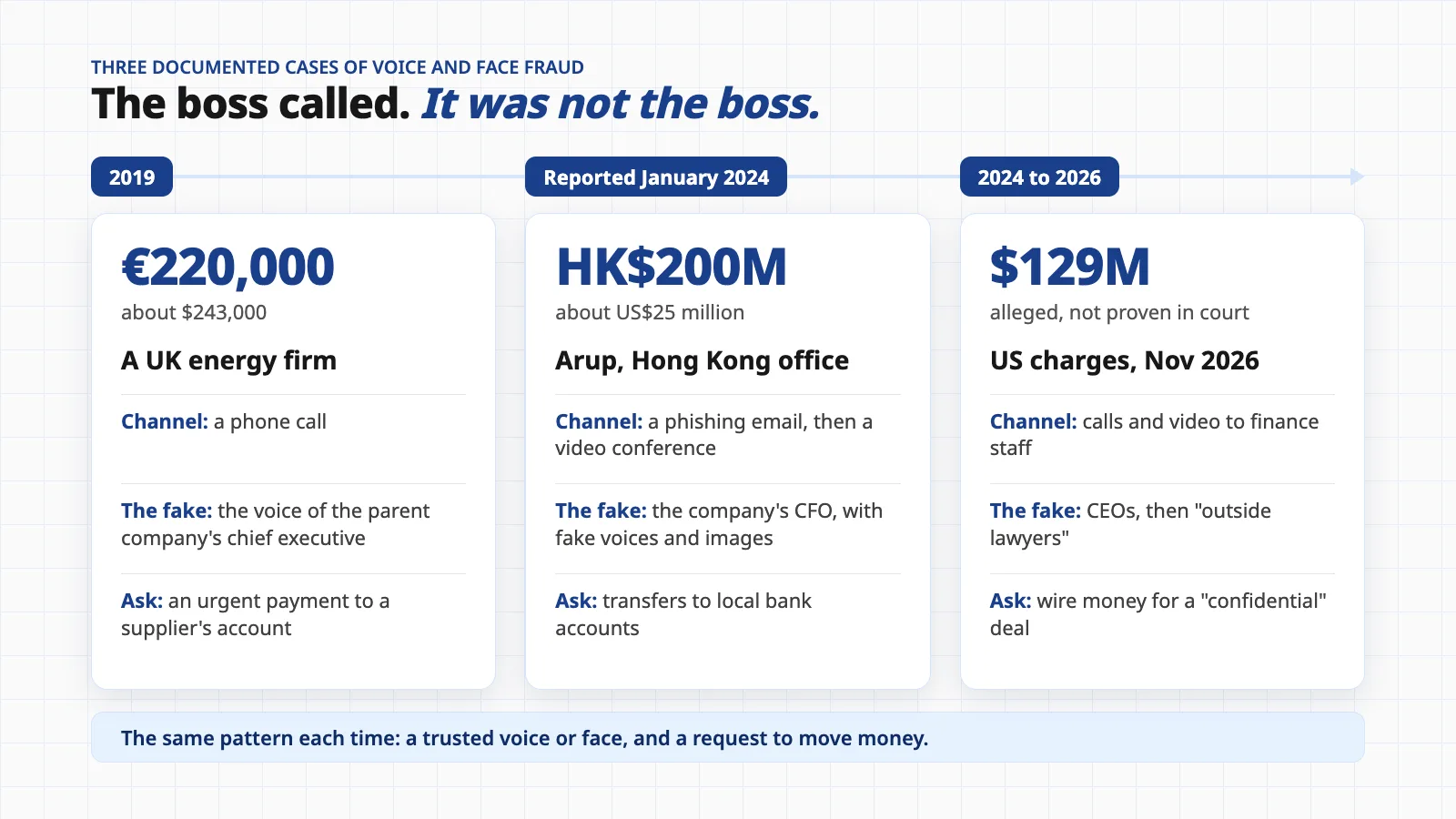
In August 2019 the Wall Street Journal reported a case in which the chief executive of a UK energy firm took a call from what sounded like the chief executive of the firm's German parent company. He was asked to send about 220,000 euros (around $243,000) to a Hungarian supplier. The insurer, Euler Hermes, which handled the claim, said the victim recognized his boss's slight German accent and the melody of his voice. The fraudsters called again for a second payment, but by then he had noticed the call came from an Austrian number, and he did not pay. The insurer believed commercial software had been used.
2024: Arup and the video conference
In late January 2024, Hong Kong police received a fraud report from a multinational's Hong Kong office. According to the Hong Kong government, the person who reported it first got a phishing email from someone pretending to be the chief financial officer at the UK head office, then was invited to a group video conference about confidential transactions. Following instructions, that person approved transfers to five local bank accounts, losing about HK$200 million, roughly US$25 million. Police said the conference was a pre-recorded fake made from public video clips and voices of the person impersonated. Afterwards the fraudster continued giving instructions through instant messaging.
In May 2024 the engineering firm Arup confirmed to CNN that it was the company. It said fake voices and images were used, and that its financial stability and business operations were not affected and no internal systems were compromised. Early press reports described a live call with several fake colleagues. The police's later written account says the meeting was pre-recorded. Either way, a real person saw and heard people who were not real.
2026: charges over cloned CEOs and fake lawyers
In November 2026 the US Attorney's Office for the Southern District of New York announced an indictment against three men. It alleges that from 2024 to early 2026 they used AI to imitate the voices, and sometimes the images, of company chief executives and of lawyers at international law firms. Calls usually went to accounting staff and described a confidential financial transaction. The staff were then directed to "attorneys" who were also part of the scheme, and told to wire money to accounts around the world. Prosecutors say the money was converted to cryptocurrency. The total is put at more than $129 million. Press reports of the indictment say the victims included a hospital system in Missouri. Two men were arrested in Spain and one in the UK.
These are allegations. The 2026 case is an indictment, not a conviction, and the defendants are presumed innocent. We cite it because the method it describes matches the other two cases and the FBI's warnings.
What the numbers show
The FBI's Internet Crime Complaint Center (IC3) collects reports of online fraud. Its 2025 annual report gives the size of the problem.
- Business email compromise (BEC). This is fraud where criminals pose as a boss, supplier or colleague to redirect payments. IC3 recorded about $3.05 billion in BEC losses in 2025, up from about $2.77 billion in 2024.
- The AI share. IC3 counted 22,364 complaints with an AI reference across all crime types, with adjusted losses above $893 million. For BEC specifically, 135 complaints referred to AI, with about $30 million in losses. The report says voice cloning can be used to request a wire payment.
- A caution about the data. IC3 says AI-enabled content is increasingly difficult to detect, and in its investment fraud section notes that many victims do not realize the extent AI may be involved. So the AI figures are probably an undercount. They are also small next to the whole BEC total, which tells you most of this fraud still starts with a plain email.
Other agencies are watching too. The FBI's December 2024 alert says criminals use AI-generated audio to impersonate well-known people or personal contacts to get payments. The US Treasury's FinCEN said in November 2024 that banks had reported more suspicious activity involving deepfake media since 2023, and asked them to flag it. In the US, impersonating a business is also unlawful under an FTC rule in force since April 2024, which lets the agency seek money back from the impersonators. None of that helps if the money has already left, so prevention is up to you.
A defense plan that fits a small team
The aim is to stop treating a voice as proof of who is asking. Every item below works even if the voice is perfect. The list is ours, built from the FBI, NCSC and Hong Kong police advice cited here.
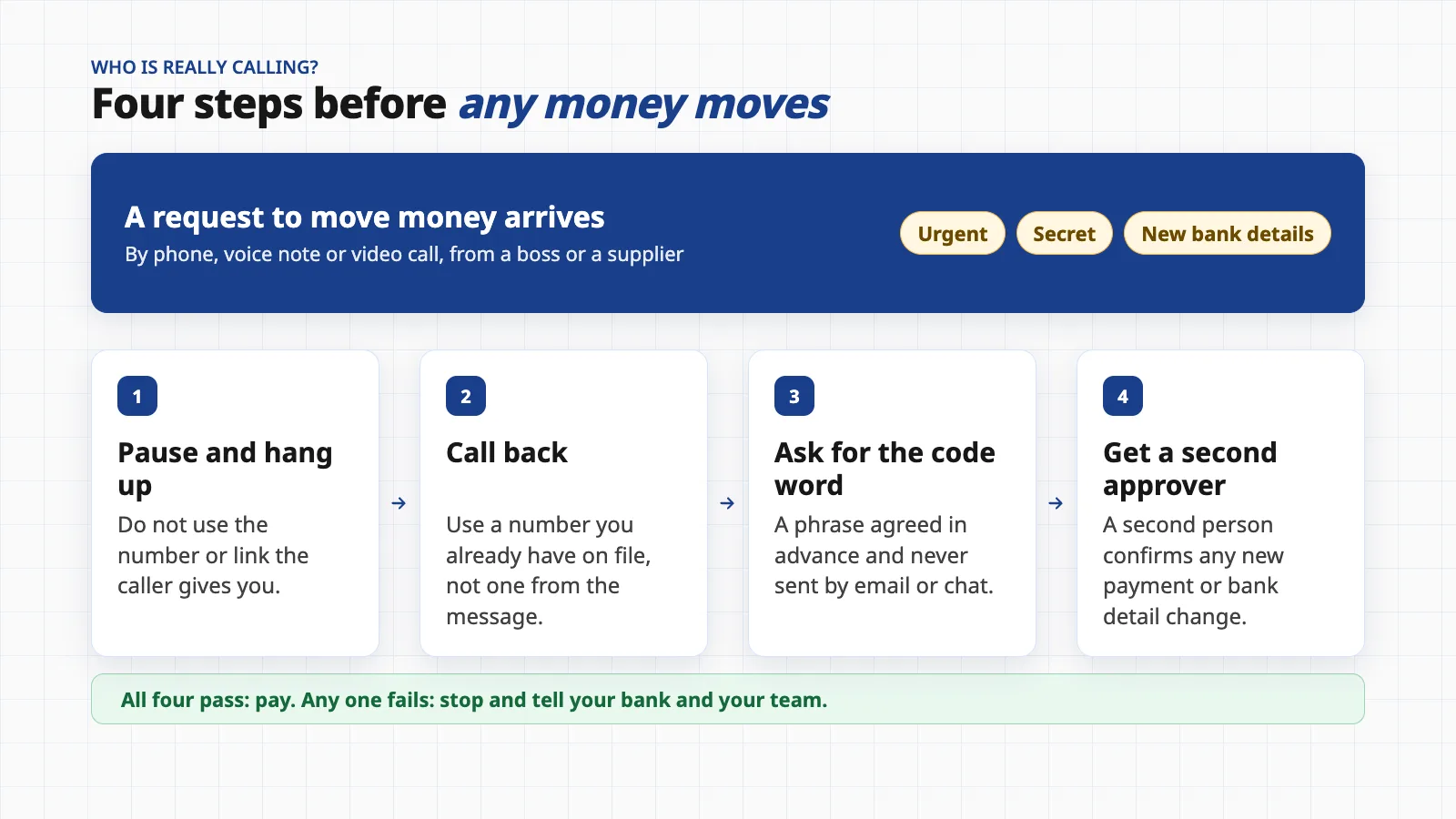
- 1. Call back on a number you already holdHang up and ring the person on the number saved in your phone or on file. The FBI says to call the number directly rather than one the caller provides. Hong Kong police advise verifying by phone any money request made by video or audio from a relative or friend, and the same logic applies to a colleague.
- 2. Agree a code wordThe FBI suggests a secret word or phrase to verify identity, a tip aimed at families. The same idea works for a finance team. Agree it in person, never put it in email or chat, and change it if it has been used on a call you doubt.
- 3. Two people approve payments and bank changesThe FBI advises verifying requests to change account details through a second channel. Make it a rule that no new payee and no changed bank details go live without a second person confirming by call-back.
- 4. A slow-down ruleNo same-hour payment on a spoken request, ever. If a request is urgent, secret and involves a new account, treat the combination as a warning sign. Real bosses accept a ten-minute delay.
- 5. Treat video as no proofPolice suggest asking a person on camera to move their head and asking questions only they could answer. Those are weak checks that will get weaker. The call-back is the strong one.
- 6. Train everyone who touches moneyThat includes assistants, reception and anyone covering for finance. Run a five-minute drill with a pretend call, and make clear that nobody gets blamed for double-checking the boss.
- 7. Do not let the voice be the lockIf a bank or tool lets you approve things by voice, ask about stronger options. The FBI advises limiting public audio and video of yourself where you can, but assume voices will leak anyway.
- 8. Protect the email behind itThe Arup case began with a phishing email. Use unique passwords and two-step sign-in on email and banking. Our guide to six cheap security habits covers this, and the vendor risk guide shows how a hacked supplier can send you convincing requests.
The first hour after a suspected scam
The FBI says time is of the essence. If you paid, do these in this order.
- Minutes 0 to 10Stop any further payments. Tell your finance lead and manager. Do not reply to the caller.
- Minutes 10 to 20Call your bank on the number from its official website or your card. Ask for a recall of the transfer. The FBI and NCSC both say to contact your bank straight away.
- Minutes 20 to 40Save evidence: call logs, the number used, voicemails, emails, chat messages, screenshots and the bank reference.
- Minutes 40 to 60Report it. In the US, file at ic3.gov, whatever the amount, since IC3 may help freeze funds, and report to the FTC at ReportFraud.ftc.gov. In England, Wales and Northern Ireland, use Report Fraud (reportfraud.police.uk, 0300 123 2040), which replaced Action Fraud in December 2025. In Scotland, call Police Scotland on 101. UK organizations can also report a cyber incident at gov.uk/report-cyber.
- Same dayCheck for a break-in behind the scam: change email and banking passwords, turn on two-step sign-in, and look for forwarding rules. Tell your insurer and read your policy's notice period.
How legitimate voice products handle consent
Geneki sells a voice AI product, so we should be straight about this. Cloning a voice is not wrong in itself. A business owner who wants their own voice on their own calls can have that. The line is consent, and what the listener is told. A legitimate product should do these things, and you can ask any vendor about each:
- Clone only with the owner's consent. The voice belongs to one person, and that person says yes in writing, from a recording of themselves.
- Say it is an AI. The call opens by telling the person they are speaking with an automated assistant. Some places require it, and the EU does under the AI Act.
- Call only people who agreed to be contacted. Not strangers, and not cold lists.
- Honor stop requests and keep a record of consent and of the calls.
VeloVoice follows the first three: a cloned voice is made only with the owner's written consent, from a short recording of their voice; we agree the opening line of each call with the customer and recommend callers are told they are speaking with an automated assistant; and outbound calls are for people who agreed to be contacted. The legal side is in our guide to the consent rules for AI calls.
One honest limit: a careful vendor cannot stop a criminal using a different tool. That is why your defenses should not depend on whether a voice sounds right.
Questions people ask
How much audio does a scammer need to clone a voice?
The FTC has warned that a scammer needs only a short audio clip of a person's voice, which can come from content posted online, plus a voice-cloning program. A conference talk, a podcast or a video on your company site can be enough, so treat any voice as copyable.
Can staff spot a cloned voice by ear?
Do not count on it. The FBI says AI-generated content is becoming increasingly difficult to detect and easier to make. In the 2019 case the victim reportedly recognized his boss's accent. Build checks that do not depend on how a voice sounds.
Is this really a risk for a small business?
Fraud that asks for payments or bank detail changes is. The FBI's IC3 recorded $3.05 billion in business email compromise losses in 2025, and most of it is not AI-related: in the AI-linked share, businesses reported about $30 million. The same defenses work against both, so protect your email too.
Will my bank get the money back?
Not always. The FBI says to contact your bank immediately and ask for a recall, and that policies vary by institution. Speed matters most, which is why the first hour matters.
What should I ask a voice AI vendor about consent?
Ask whose voice is cloned, whether the owner agreed in writing, whether they can withdraw it, whether calls announce that the speaker is an AI, who is called and with what permission, and how stop requests are handled.
Want a second pair of eyes on your setup?
Geneki can review your accounts, email and access settings and help you put the basics in place, so one convincing call cannot become a loss. Talk to us.
Talk to usSources
- Fraudsters used AI to mimic CEO's voice in unusual cybercrime case
- LCQ9: Combating frauds involving deepfake
- Arup revealed as victim of $25 million deepfake scam involving Hong Kong employee
- Three foreign nationals arrested and charged with scheme to use super intelligence to defraud companies of $129 million
- 3 foreign nationals allegedly used AI to mimic CEOs in $129M scheme, DOJ says
- Criminals use generative artificial intelligence to facilitate financial fraud (I-120324-PSA)
- Business email compromise: the $55 billion scam (I-091124-PSA)
- 2025 Internet Crime Report
- FinCEN alert on fraud schemes involving deepfake media targeting financial institutions (FIN-2024-Alert004)
- Scammers use AI to enhance their family emergency schemes
- 16 CFR Part 461: Rule on Impersonation of Government and Businesses
- Business payment fraud
- Report Fraud: new service from City of London Police
- Our guide: six cheap habits for small-business security
- Our guide: when a vendor gets hacked
This guide is general information, not legal or financial advice. The 2019 case details come from press reporting of the insurer's account, and the Arup details from the Hong Kong government and Arup's statement to the media. The 2026 US case is an indictment: the charges are allegations, and the defendants are presumed innocent. Figures are as reported in each source and can differ between sources.